Advertisements
Advertisements
प्रश्न
Find the sentences in the lesson which have the adverbs given in the box below.
Awfully, sorrowfully, completely, loftily, carefully, differently, quickly, nonchalantly
Advertisements
उत्तर
They turned the pages, which were yellow and crinkly, and it was awfully funny to read words that stood still instead of moving the way they were supposed to − on a screen, you know.
The mechanical teacher had been giving her test after test in geography and she had been
doing worse and worse until her mother had shaken her head sorrowfully and sent for the
County Inspector. They had once taken Tommy’s teacher away for nearly a month because the history sector had blanked out completely. He added loftily, pronouncing the word carefully, “Centuries ago.”
“But my mother says a teacher has to be adjusted to fit the mind of each boy and girl it
teaches and that each kid has to be taught differently.”
“I didn’t say I didn’t like it,” Margie said quickly.
“May be,” he said nonchalantly.
संबंधित प्रश्न
Based on your reading of the story, answer the following question by choosing the correct option:
“The very naming of Harold had caused a sacrifice on his part.” The writer’s tone here is
Look at the passage below and study how the personal pronouns refer to different people.
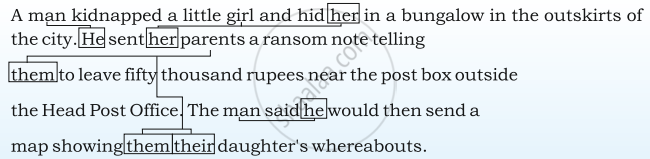
Read these sentences from the story.
1. We will go to the old man.
2. Iwillopenmyhands.
3. It will flyaway.
4. I will crush the butterfly.
The modal will is used to talk about a temporary event in progress at some
point in future.
Will is used to denote _________ time.
Did you know?
There are different constructions in English which can be used to refer to
future time.
1. Use of the simple present tense.
a. The IPL begins on 20th April.
b. If the newly introduced vaccine works, AIDS can be cured.
2. Use of shall/will
Will/shall is used to make a prediction about future events, in
advertisements, posters etc.
e.g. a. You will win the 1st prize.
b. The Nano car will be on the roads soon.
c. You shall lead a happy life.
3. Use of going to
Going to is normally used to refer to future events in two cases
(a) If there is a present indication of the future event.
e.g. India is going to emerge as a Super Power in 2020.
(b) to express intention
e.g. Smitha is going to marry Akshay.
4. Use of present continuous tense (be+ verb+ ing)
Present continuous tense is used to refer to future events that have been
already planned.
e.g. a. I'm meeting the Project Manger this evening.
b. I'm sorry I can't meet you tomorrow. I'm visiting my friend.
5. Use of be + about to + infinitive.
e.g. The train is about to leave.
6. Useofbe+to+v
e.g. Obama is to visit India in October.
What does he plant who plants a tree? a
He plants a friend of sun and sky;b
He plants the flag of breezes free;
The shaft of beauty, towering high;
He plants a home to heaven anigh;
For song and mother-croon of bird
In hushed and happy twilight heard____
The treble of heaven's harmony_____
These things he plants who plants a tree.
Read the lines given above and answer the question that follow:
The most important thing we've learned,
So far as children are concerned,
Is never, NEVER, NEVER let
Them near your television set-----
Or better still, just don't install
The Idiotic thing at all.
In almost every house we've been,
we've watched them gaping at the screen
They loll and slop and lounge about,
And stare until their eyes pop out.
(Last week in someone's place we saw
A dozen eyeballs on the floor.
They sit and stare and stare and sit
Until they're hypnotised by it,
Until they're absolutely drunk
With all that shocking ghastly junk.
Read the lines given above and answer the question given below.
Name some of the things that the poet has seen in house which have televisions.
Of the seven hundred villages dotting the map of India, in which the majority of India’s five hundred million live, flourish and die, Kritam was probably the tiniest, indicated on the district survey map by a microscopic dot, the map being meant more for the revenue official out to collect tax than for the guidance of the motorist, who in any case could not hope to reach it since it sprawled far from the highway at the end of a rough track furrowed up by the iron-hooped wheels of bullock carts. But its size did not prevent its giving itself the grandiose name Kritam, which meant in Tamil coronet or crown on the brow of the subcontinent. The village consisted of fewer than thirty houses, only one of them built from brick and cement and painted a brilliant yellow and blue all over with
gorgeous carvings of gods and gargoyles on its balustrade, it was known as the Big House. The other houses, distributed in four streets, were generally of bamboo thatch, straw, mud and other unspecified material. Muni’s was the last house in the fourth street, beyond which stretched the fields. In his prosperous days Muni had owned a flock of sheep and goats and sallied forth every morning driving the flock to the highway a couple of miles away.
Read the extract given below and answer the question that follow.
Describe Muni’s prosperous days.
Mr. Oliver, an Anglo-Indian teacher, was returning to his school late one night on the outskirts of the hill station of Shimla. The school was conducted on English public school lines and the boys – most of them from well-to-do Indian families – wore blazers, caps and ties. “Life” magazine, in a feature on India, had once called this school the Eton of the East.
Mr. Oliver had been teaching in this school for several years. He’s no longer there. The Shimla Bazaar, with its cinemas and restaurants, was about two miles from the school; and Mr. Oliver, a bachelor, usually strolled into the town in the evening returning after dark, when he would take short cut through a pine forest.
Read the extract given below and answer the question that follow.
Who was Mr Oliver? Where was he working?
Suddenly all the tension seemed to ebb out of my body as the truth of what he said hit me. Confidently, I drew a line a full foot in back of the board and proceeded to jump from there. I qualified with almost a foot to spare.
That night I walked over to Luz Long’s room in the Olympic village to thank him. I knew that if it hadn’t been for him I probably wouldn’t be jumping in the finals the following day. We sat in his quarters and talked for two hours—about track and field, ourselves, the world situation, a dozen other things.
When I finally got up to leave, we both knew that a real friendship had been formed. Luz would go out to the field the next day trying to beat me if he could. But I knew that he wanted me to do my best—even if that meant my winning.
Read the extract given below and answer the question that follow.
Suddenly all the tension seemed to ebb out of my body as the truth of what he said hit me.
They stood in the doorway of the underground for a moment until it was raining hard. Then they closed the door and heard the gigantic sound of the rain falling in tons and avalanches, everywhere and forever.
“Will it be seven more years?” “Yes. Seven.” Then one of them gave a little cry. “Margot!” “What?” “She’s still in the closet where we locked her.” “Margot.”
They stood as if someone had driven them, like so many stakes, into the floor. They looked at each other and then looked away. They glanced out at the world that was raining now and raining and raining steadily. They could not meet each other’s glances. Their faces were solemn and pale. They looked at their hands and feet, their faces down. “Margot.” One of the girls said, “Well.. .?” No one moved. “Go on,” whispered the girl. They walked slowly down the hall in the sound of the cold rain. They turned through the doorway to the room in the sound of the storm and thunder, lightning on their faces, blue and terrible. They walked over to the closet door slowly and stood by it. Behind the closed door was only silence. They unlocked the door, even more slowly, and let Margot out.
Read the extract given below and answer the question that follow.
Why does the author describe their faces as blue and terrible?
From the third paragraph pick out
(i) words associated with cries of birds,
(ii) words associated with noise,
(iii) words suggestive of confusion and fear.
Discuss in small groups
• Has Rukku Manni done exactly the same as the children? In your opinion, then, is it right for one party to blame the other?
Who was Gopal?
Why do you think we should be kind towards animals?
What made the ghost believe Vijay Singh was dead?
Why is the child asked to stand straight?
How did the villagers come to know of the magic waterfall?
Speak the following sentences clearly but as quickly as you can learn them by heart.
1. How much wood would a woodchuck chuck if a woodchuck would chuck wood.
2. Betty bought a bit of butter, but the bit of butter was a little bitter so she bought some better butter to make the bitter butter better.
Replace the italicised portion of the sentence below with a suitable phrase from the box. Make necessary changes, wherever required.
The best way to avoid an unnecessary argument is to remain silent.
Read the lines given below and answer the following question:
| “But my darling, if you love me,” thought Miss Meadows, “I don’t Mind how much it is. Love me as little as you like.” |
What was the effect of Basil’s letter on Miss Meadows?
With close reference to Act V, describe how Prospero has used the spirits of "hills, brooks, groves" to give shape to his magical acts. What does he finally decide to do with his magical powers?
