Advertisements
Advertisements
प्रश्न
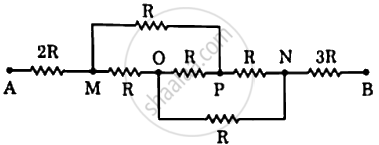
Find net resistance of the network of resistors connected between A and B, as shown in figure.
Advertisements
उत्तर
To find the net resistance between points A and B, we can break the circuit down into three main sections in series, the resistor between A and M, the network between M and N, and the resistor between N and B.
The central part of the circuit (between nodes M, O, P, and N) forms a Wheatstone bridge structure. Let’s identify the branches:
Arm MP: Resistor R (top branch)
Arm MO: Resistor R (left middle branch)
Arm PN: Resistor R (right middle branch)
Arm ON: Resistor R (bottom branch)
Central Arm OP: Resistor R (connecting the two parallel paths)
We check if the bridge is balanced by comparing the ratios of the resistances of opposite arms:
`R_(MP)/R_(MO) = R/R` = 1 and
`R_(PN)/R_(ON) = R/R` = 1
Since the ratios are equal, the bridge is balanced. This means there is no potential difference between nodes O and P, and no current flows through the resistor in the central arm (OP).
Since no current flows through the central resistor, we can remove it to simplify the calculation. The network between M and N then consists of two parallel branches:
Upper branch (M-P-N): Two resistors R in series.
Rupper = R + R
= 2R
Lower branch (M-O-N): Two resistors R in series.
Rlower = R + R
= 2R
The equivalent resistance RMN is the parallel combination of these two branches:
`1/R_(MN) = 1/(2R) + 1/(2R)`
`1/R_(MN) = 2/(2R)`
`1/R_(MN) = 1/R`
RMN = R
Now, we simplify and add the resistances of the three sections connected in series:
RAM = 2R
RMN = R
RNB = 3R
RAB = RAM + RMN + RNB
= 2R + R + 3R
= 6R
