Advertisements
Advertisements
प्रश्न
Find `int (2x)/((x^2 + 1)(x^4 + 4))`dx
Advertisements
उत्तर
Let x2 = t
2xdx = dt
`=> dx = dt/(2x)`
`I = int (2x)/((x^2 + 1)(x^4 + 4)) dx`
`= int (dt)/((t +1)(t^2 + 4))`
Let `1/((t + 1)(t^2 + 4)) = A/(t + 1) + (Bt + C)/(t^2+4)` .....(1)
`=> 1 = A(t^2 + 4) + (Bt + C) (t + 1)` ...(2)
Putting t=−1 in (2)
1 = A(1 + 4) +0
⇒5A = 1
`=> A = 1/5`
Putting t = 0 in 2
4A + C = 1
`=>C = 1 - 4/5`
`=> C = 1/5`
Putting t = 1 in (2)
1 = 5A + 2B + 2C
`=> -2B = 2/5`
`=>B = (-1)/5`
Putting the values of A, B and C in (1)
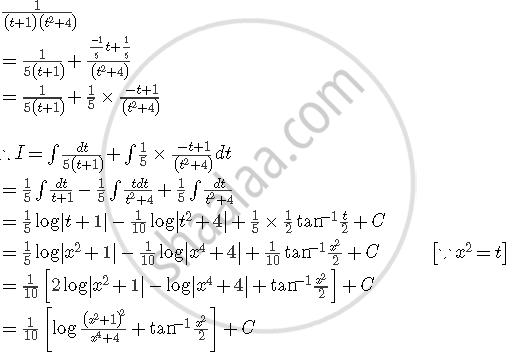
APPEARS IN
संबंधित प्रश्न
Find the integrals of the function:
sin2 (2x + 5)
Find the integrals of the function:
sin 3x cos 4x
Find the integrals of the function:
cos 2x cos 4x cos 6x
Find the integrals of the function:
sin3 (2x + 1)
Find the integrals of the function:
sin 4x sin 8x
Find the integrals of the function:
tan4x
Find the integrals of the function:
`(cos 2x+ 2sin^2x)/(cos^2 x)`
`int (e^x(1 +x))/cos^2(e^x x) dx` equals ______.
Find `int dx/(x^2 + 4x + 8)`
Differentiate : \[\tan^{- 1} \left( \frac{1 + \cos x}{\sin x} \right)\] with respect to x .
Find `int_ (sin "x" - cos "x" )/sqrt(1 + sin 2"x") d"x", 0 < "x" < π / 2 `
Find the area of the triangle whose vertices are (-1, 1), (0, 5) and (3, 2), using integration.
Find:
`int"dx"/sqrt(5-4"x" - 2"x"^2)`
Integrate the function `cos("x + a")/sin("x + b")` w.r.t. x.
Find: `int sec^2 x /sqrt(tan^2 x+4) dx.`
Find `int x^2tan^-1x"d"x`
`int "e"^x (cosx - sinx)"d"x` is equal to ______.
`int (sin^6x)/(cos^8x) "d"x` = ______.
Evaluate the following:
`int ("d"x)/(1 + cos x)`
Evaluate the following:
`int (sinx + cosx)/sqrt(1 + sin 2x) "d"x`
Evaluate the following:
`int (sin^6x + cos^6x)/(sin^2x cos^2x) "d"x`
Evaluate the following:
`int "e"^(tan^-1x) ((1 + x + x^2)/(1 + x^2)) "d"x`
Evaluate the following:
`int sin^-1 sqrt(x/("a" + x)) "d"x` (Hint: Put x = a tan2θ)
`int (x + sinx)/(1 + cosx) "d"x` is equal to ______.
`int sinx/(3 + 4cos^2x) "d"x` = ______.
The value of the integral `int_(1/3)^1 (x - x^3)^(1/3)/x^4 dx` is
Which identity is used for \(\cos^2 x\)?
What is \(\int \sin 2x\cos 3x\,dx\)?
