Advertisements
Advertisements
प्रश्न
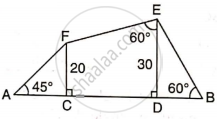
Find AB.
Advertisements
उत्तर
Consider the figure
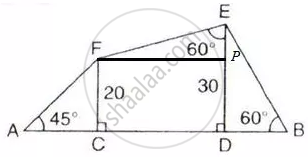
From right triangle ACF
tan 45° = `(20)/"AC"`
1 = `(20)/"AC"`
AC = 20 cm
From triangle DEB
tan 60° = `(30)/"BD"`
`sqrt(3) = (30)/"BD"`
BD = `(30)/sqrt(3)` = 17.32 cm
Given FC = 20, ED = 30, So EP = 10 cm
Therefore
tan 60° = `"FP"/"EP"`
`sqrt(3)= "FP"/(10)`
FP = `10sqrt(3)` = 17.32 cm
Thus AB = AC + CD + BD = 54.64 cm.
APPEARS IN
संबंधित प्रश्न
Find 'x', if :
Find the length of AD.
Given: ∠ABC = 60o.
∠DBC = 45o
and BC = 40 cm.

In trapezium ABCD, as shown, AB // DC, AD = DC = BC = 20 cm and ∠ A = 60°. Find: length of AB

In the given figure, AB and EC are parallel to each other. Sides AD and BC are 2 cm each and are perpendicular to AB.

Given that ∠ AED = 60° and ∠ ACD = 45°. Calculate: AB.
In the given figure, AB and EC are parallel to each other. Sides AD and BC are 2 cm each and are perpendicular to AB.

Given that ∠ AED = 60° and ∠ ACD = 45°. Calculate: AE.
A ladder is placed against a vertical tower. If the ladder makes an angle of 30° with the ground and reaches upto a height of 15 m of the tower; find length of the ladder.
A kite is attached to a 100 m long string. Find the greatest height reached by the kite when its string makes an angles of 60° with the level ground.
Find AB and BC, if:

Find AB and BC, if:

Find PQ, if AB = 150 m, ∠ P = 30° and ∠ Q = 45°.

