Advertisements
Advertisements
प्रश्न
Fill in the following blank with suitable word:
Ethene and ethyne are examples of ..... hydrocarbons.
Advertisements
उत्तर
Ethene and ethyne are examples of unsaturated hydrocarbons.
APPEARS IN
संबंधित प्रश्न
State any four characteristics of a homologous series
Classify the following carbon compounds into two homologous series and name them.
C3H4, C3H6, C4H6, C4H8, C5H8, C5H10
Write the name and formula of the 2nd member of homologous series having general formula CnH2n – 2.
The following vegetables are kept in a basket :
Potato, Tomato, Radish, Brinjal, Carrot, Bottle-gourd
Which two of these vegetables correctly represent the homologous structures?
(A) Carrot and Tomato
(B) Potato and Brinjal
(C) Radish and Carrot
(D) Radish and Bottle-gourd
Write the molecular formula of the 2nd and 3rd member of the homologous series where the first member is ethyne.
Complete the following table which relates to the homologous series of hydrocarbons.
|
General Formula |
IUPAC name of the homologous series | Characteristic bond type | IUPAC name of the first member of the series |
| `C_nH_(2n-2)` | (A)________ | (B)______ | (C)______ |
| C_nH_(2n+1) | (B)________ | (E)______ | (F)______ |
Give the molecular formula of one homologue of the following:
C3H6
A colourless organic liquid X of molecular formula C2H4O2 turns blue litmus to red. Another colourless organic liquid Y of molecular formula C3H6O has no action on any litmus but it is used as a nail polish remover. A yet another colourless organic liquid Z of molecular formula C2H6O has also no action on litmus but it is used in tincture of iodine.
(a) Name the liquid X. To which homologous series does it belong? Give the name of another member of this homologous series.
(b) Name the liquid Y. To which homologous series does it belong? Write the name of another member of this homologous series.
(c) Can you name an organic compound having the same molecular formula as liquid Y but which belongs to a different homologous series? What is this homologous series?
(d) Name the liquid Z. To which homologous series does it belong? Write the name of another member of this homologous series.
Give the abbreviated formula of the third member of the alcohol.
What is the difference in the molecular formula of any two adjacent homologues in terms of molecular mass?
Why homologous series of carbon compounds are so called? Write chemical formula of two consecutive members of a homologous series and state the part of these compounds that determines their (i) physical properties, and (ii) chemical properties.
Define homologous series of organic compounds. List its two characteristics. Write the name and formula of the first member of the series of alkenes.
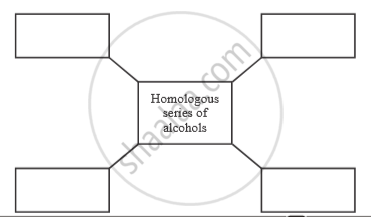
Write names of first four homologous series of alcohols.
Give three points to differentiate between saturated and unsaturated
hydrocarbons.
What is a homologous series?
Assertion (A): In a homologous series of alcohols, the formula for the second member is C2H5OH and the third member is C3H7OH.
Reason (R): The difference between the molecular masses of the two consecutive members of a homologous series is 144.
Write a short note.
Homologous series
