Advertisements
Advertisements
प्रश्न
Simple Present Tense
In these sentences words like everyday, often, seldom, never, every
month, generally, usually, etc. may be used.
Fill in the blank with the correct form of the verb in brackets.
Mahesh: We have to organise a class party for our teacher. ___(Do) anyone play an
instrument?
Vipul: Rohit ___(play) the flute.
Mahesh: ___(Do) he also act?
Vipul: No, he ___(compose) music.
Mahesh: That’s wonderful!
Advertisements
उत्तर
Mahesh: We have to organise a class party for our teacher. Does anyone play an
instrument?
Vipul: Rohit plays the flute.
Mahesh: Does he also act?
Vipul: No, he composes music.
Mahesh: That’s wonderful!
संबंधित प्रश्न
Answer these question in a few words or a couple of sentence.
When was her deafness first noticed? When was it confirmed?
Who is the real culprit according to the king? Why does he escape punishment?
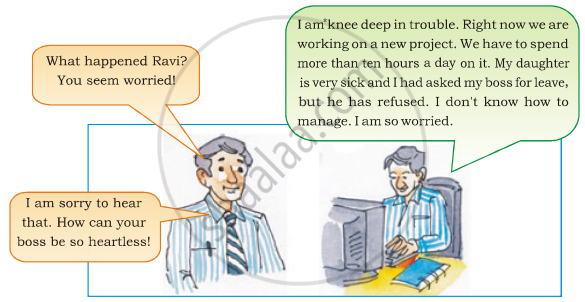
Read the following conversation between two friends.
Read the poem silently.
Two roads diverged in a yellow wood,
And sorry I could not travel both
And be one traveller, long I stood
And looked down one as far as I could
To where it bent in the undergrowth;
Then took the other, as just as fair,
And having perhaps the better claim,
Because it was grassy and wanted wear;
Though as for that the passing there
Had worn them really about the same,
And both that morning equally lay
In leaves no step had trodden black.
Oh, I kept the first for another day!
Yet knowing how way leads on to way,
I doubted if I should ever come back.
I shall be telling this with a sigh
Somewhere ages and ages hence:
Two roads diverged in a wood, and II
took the one less travelled by,
And that has made all the difference.
About the Poet
Robert Frost (1874-1963) was born in San Franscisco, Frost spent most of his adult
life in rural New England and his laconic language and emphasis on individualism in
his poetry reflect this region. He attended Dartmouth and Harvard but never earned a
degree. As a young man with a growing family he attempted to write poetry while
working on a farm and teaching in a school. American editors rejected his submitted
poems. With considerable pluck Frost moved his family to England in 1912 and the
following year, a London publisher brought out his first book. After publishing a
second book, Frost returned to America determined to win a reputation in his own
country, which he gradually achieved. He became one of the country's best-loved
poets. Unlike his contemporaries, Frost chose not to experiment with the new verse
forms but to employ traditional patterns, or as he said, he chose "the old-fashioned
way to be new." Despite the surface cheerfulness and descriptive accuracy of his
poems, he often presents a dark, sober vision of life, and there is a defined thoughtful
quality to his work which makes it unique.
She again rubbed a match on the wall, and the light shone round her; in the brightness stood her old grandmother, clear and shining, yet mild and loving in her appearance. “Grandmother,” cried the little one, “O take me with you; I know you will go away when the match burns out; you will vanish like the warm stove, the roast goose, and the large, glorious Christmas-tree.” And she made haste to light the whole bundle of matches, for she wished to keep her grandmother there. And the matches glowed with a light that was brighter than the noon-day, and her grandmother had never appeared so large or so beautiful. She took the little girl in her arms, and they both flew upwards in brightness and joy far above the earth, where there was neither cold nor hunger nor pain, for they were with God.
In the dawn of morning there lay the poor little one, with pale cheeks and smiling mouth, leaning against the wall; she had been frozen to death on the last evening of the year; and the New-year’s sun rose and shone upon a little corpse! The child still sat, in the stiffness of death, holding the matches in her hand, one bundle of which was burnt. “She tried to warm herself,” said some. No one imagined what beautiful things she had seen, nor into what glory she had entered with her grandmother, on New-year’s day.
Read the extract given below and answer the question that follow.
Why was there a smile on the girl’s lips? Did the people understand?
I was in for a surprise. When the time came for the broad-jump trials, I was startled to see a tall boy hitting the pit at almost 26 feet on his practice leaps! He turned out to be a German named Luz Long. 1 was told that Hitler hoped to win the jump with him. I guessed that if Long won, it would add some new support to the Nazis’ “master race” (Aryan superiority) theory. After all, I am a Negro. Angr about Hitler’s ways, 1 determined to go out there and really show Der Fuhrer and his master race who was superior and who wasn’t. An angry athlete is an athlete who will make mistakes, as any coach will tell you. I was no exception. On the first of my three qualifying jumps, I leaped from several inches beyond the takeoff board for a foul. On the second jump, I fouled even worse. “Did I come 3,000 miles for this?” I thought bitterly. “To foul out of the trials and make a fool of myself ?” Walking a few yards from the pit, 1 kicked disgustedly at the dirt.
Read the extract given below and answer the question that follow.
Why did Owens kick the pit in disgust?
How, according to Portia, can the Duke of Saxony’s nephew be made to choose the wrong casket? What do these suitors ultimately decide? Why?
Read the extract given below and answer the questions that follow:
Portia: .......But this reasoning is not in fashion to choose me a husband. O me, the word “choose”! I may neither choose who I would, nor refuse whom I dislike; so is the will of a living daughter curbed by the will of a dead father. Is it not hard, Nerissa, that I cannot choose one, nor refuse none?
(i) What test had Portia’s father devised for her suitors? What oath did the suitors have to take before making their choice?
(ii) Who is Nerissa? What does she say to cheer up Portia?
(iii) Why does Portia disapprove of the County Palatine? Who would she rather marry?
(iv) How, according to Portia, can the Duke of Saxony’s nephew be made to choose the wrong casket? What do these suitors ultimately decide? Why?
(v) Whom does Portia ultimately marry? Who were the two other suitors who took the test? Why, in your opinion, is the person whom she marries worthy of her?
Read the extract given below and answer the questions that follow:
"What's your name ?" he asked.
"Bmillnvaite," I replied, "Ricardo Bmithwaite.
'"I'm Pinkus and this is Mama Pinkus."
The introduction was effected with a filial devoti~ which was good to see.
"How d'you do, Mama Pinkus."
"I think I know someplace for you." He went the little noticeboard and removed a small car, on which was written a short advertisement of, room to let near-by.
(i) Why was Braithwaite looking for a new placet? stay? Why was he impressed by the place that was on rent?
(ii) What reception did Ile get wizen he reached the address that had been advertised? Whom did tit house belong to?
(iii) Why did Mrs. Pegg come lo see Braithwaite? Wh• reply did Braithwaite give to her?
(iv) What changes occurred in Pamela's persona/ii after the August holiday?
(v) What comment did Potter make wizen Braithwait? hurt himself? What did he mean by that comment How did Pamela react to Potter's remark?
Discuss the following topic in groups.
Why did the wise old bird say, “Chandni is the winner”?
Was the spacecraft manned or unmanned? How do you know it?
When does the kite seem to take rest?
What does the poem Whatif talk about? Give a few examples of some of the child’s worries or cynical fears.
Who says this to whom and why?
“I can’t pay you a penny for the wretched beast you sold me.”
Identify the line that has been repeated often in the poem.
Why does the poet want to peep through the window as he passes it?
Use a, an or the in the blanks.
There was once ______ play which became very successful. ………… famous actor was acting in it. In ………. play his role was that of ……….. aristocrat who had been imprisoned in …………. castle for twenty years. In……… last act of ……….. play someone would come on ……… stage with ………… letter which he would hand over to ……….. prisoner. Even though …………. aristocrat was not expected to read ………. letter at each performance, he always insisted that ………… letter be written out from beginning to end.
Read the extract given below and answer the questions that follow:
| Portia: | ... Lorenzo, I commit into your hands The husbandry and manage of my house Until my lord's return: for mine own part, I have toward heaven breathed a secret vow To live in prayer and contemplation, Only attended by Nerissa here, Until her husband and my lord's return. |
- Who does Portia refer to as 'my lord'?
Where is her lord?
Why had he left in such haste? [3] - What does Portia ask Lorenzo to do? Why does she make this request? [3]
- Explain, in your own words, the ‘secret vow’ that Portia speaks of. [3]
- What instruction does Portia give to her servant, a little later in the scene? [3]
- What do we learn about Portia’s real intention from her conversation with Nerissa?
Which Portia do you prefer- the modest Portia of the Casket scene or the businesslike Portia we meet in this scene?
Give one reason for your response. [4]
In the short story, Fritz, what had happened to Fritz according to Jayanta?
Read the extract given below and answer the questions that follow:
| Brutus: | I did send to you For certain sums of gold, which you denied me; For I can raise no money by vile means: By heaven, I had rather coin my heart, And drop my blood for drachmas, than to wring From the hard hands of peasants their vile trash By any indirection. |
- To whom are these words addressed?
Why is Brutus angry with this person? [3] - How does this person feel when he hears these words?
What does he say to defend himself? [3] - Why did Brutus need ‘certain sums of gold’?
Why was he unable to raise these sums of money? [3] - Earlier in this scene, Brutus refers to Lucius Pella.
What had he been accused of?
Who had supported him and how? [3] - Mention any two aspects of Brutus’ character that are revealed in the above extract.
What do you understand about the relationship between Brutus and the person he addresses? [4]
