Advertisements
Advertisements
प्रश्न
Explain various types of friction.
Advertisements
उत्तर
There are two types of Friction:
(1) Static Friction:
Static friction is the force that opposes the initiation of motion of an object on the surface. The magnitude of static frictional force fs lies between
0 ≤ fs ≤ μsN
where, µs – coefficient of static friction
N – Normal force
(2) Kinetic friction:
The frictional force exerted by the surface when an object slides is called kinetic friction. Also called sliding friction or dynamic friction,
fk – µkN
where µk – the coefficient of kinetic friction
N – Normal force exerted by the surface on the object
APPEARS IN
संबंधित प्रश्न
People often say “For every action, there is an equivalent opposite reaction”. Here they meant ‘action of a human’. Is it correct to apply Newton’s third law to human actions? What is mean by ‘action’ in Newton's third law? Give your arguments based on Newton’s laws.
Briefly explain the origin of friction. Show that in an inclined plane, the angle of friction is equal to the angle of repose.
If a body of mass m is moving on a rough horizontal surface of coefficient of kinetic friction µ, the net resultant force exerted by surface on the body is ______.
A 40 kg wooden crate is being pushed across a wooden floor with a force of 160 N. If µk = 0.3, the acceleration of the crate is ______ m/s2. (g = 10 m/s2}
A block of mass m = 1 kg moving on horizontal surface with speed u = 2 m/s enters a rough horizontal patch ranging from x = 0.10 m to x = 2.00 m. If the retarding force fr on the block in this range is inversely proportional to x over this range i.e.
fr = `"-k"/x` 0.10 < x < 2.00
= 0 for x < 0.10 and x > 2.00
If k = 0.5 J then the speed of this block as it crosses the patch is (use ℓn 20 = 3)
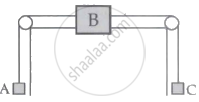
Block A has a mass of 2 kg and block B has 20 kg. If the coefficient of kinetic friction between block B and the horizontal surface is 0.1, and B is accelerating towards the right with a = 2 m/s2, then the mass of the block C will be ______.
(g = 10 m/s2)
A chain of mass 'M' and length 'L' is put on a rough horizontal surface and is pulled by constant horizontal force 'F' as shown in the figure. The velocity of the chain as it turns completely ______.
(Coefficient of friction = μ)

A block of mass 10 kg starts sliding on a surface with an initial velocity of 9.8 ms-1. The coefficient of friction between the surface and bock is 0.5. The distance covered by the block before coming to rest is ______.
[use g = 9.8 ms-2]
There are two inclined surfaces of equal length (L) and same angle of inclination 45° with the horizontal. One of them is rough and the other is perfectly smooth. A given body takes 2 times as much time to slide down, on rough surface than on the smooth surface. The coefficient of kinetic friction (μ) between the object and the rough surface is close to ______.
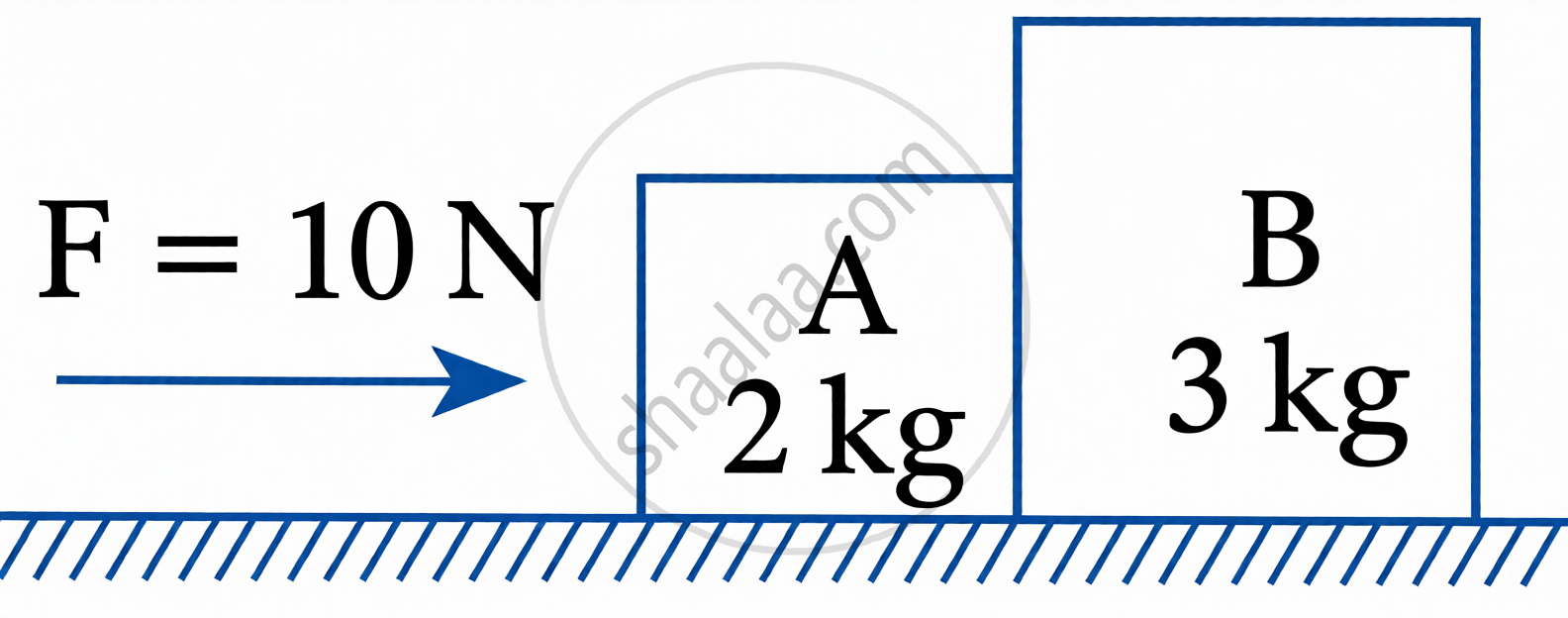
A horizontal force 10 N is applied to a block A as shown in figure. The mass of blocks A and B are 2 kg and 3 kg, respectively. The blocks slide over a frictionless surface. The force exerted by block A on block B is: