Advertisements
Advertisements
प्रश्न
Briefly explain the origin of friction. Show that in an inclined plane, the angle of friction is equal to the angle of repose.
Advertisements
उत्तर
If a very gentle force in the horizontal direction is given to an object at rest on the table it does not move. It is because of the opposing force exerted by the surface on the object which resists its motion. This force is called the frictional force. During the time of Newton and Galileo, a frictional force was considered as one of the natural forces like a gravitational force. But in the twentieth century, the understanding of atoms, electrons, and protons has changed the perspective.
The frictional force is actually the electromagnetic force between the atoms on the two surfaces. Even well-polished surfaces have irregularities on the surface at the microscopic level. The component of force parallel to the inclined plane (mg sin θ) tries to move the object down. The component of force perpendicular to the inclined plane (mg cos θ) is balanced by the Normal force (N).
N = mg cos θ ………(1)
When the object just begins to move, the static friction attains its maximum value
`f_s = f_s^"max" = mu_sN`
This friction also satisfies the relation
`f_s^"max"` = µs mg sin θ ……….(2)
Equating the right-hand side of equations (1) and (2),
`(f_s^"max")"/"N = sintheta/costheta`
From the definition of angle of friction, we also know that
tan θ = µs ………..(3)
in which θ is the angle of friction.
Thus the angle of repose is the same as the angle of friction. But the difference is that the angle of repose refers to inclined surfaces and the angle of friction is applicable to any type of surface.
APPEARS IN
संबंधित प्रश्न
An object of mass m begins to move on the plane inclined at an angle θ. The coefficient of static friction of inclined surfaces is µs. The maximum static friction experienced by the mass is ______
Explain various types of friction.
Suggest a few methods to reduce friction.
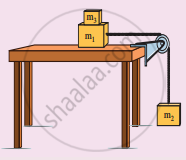
Two masses m1 and m2 are connected with a string passing over a frictionless pulley fixed at the comer of the table as shown in the figure. The coefficient of static friction of mass m1 with the table is µs Calculate the minimum mass m3 that may be placed on m1 to prevent it from sliding. Check if m1 = 15 kg, m2 = 10 kg, m3 = 25 and µs = 0.2.
Briefly explain ‘rolling friction.'
A heavy uniform chain lies on a horizontal table. If the coefficient of friction between the chain and the table is 0.25, then the maximum fraction of the length of the chain that can hang over one edge of the table is
A block of mass m slides along a floor while a force of magnitude F is applied to it at an angle θ as shown in figure. The coefficient of kinetic friction is µK. Then, the block's acceleration 'a' is given by ______.
(g is acceleration due to gravity)

A 40 kg wooden crate is being pushed across a wooden floor with a force of 160 N. If µk = 0.3, the acceleration of the crate is ______ m/s2. (g = 10 m/s2}
A block of mass m = 1 kg moving on horizontal surface with speed u = 2 m/s enters a rough horizontal patch ranging from x = 0.10 m to x = 2.00 m. If the retarding force fr on the block in this range is inversely proportional to x over this range i.e.
fr = `"-k"/x` 0.10 < x < 2.00
= 0 for x < 0.10 and x > 2.00
If k = 0.5 J then the speed of this block as it crosses the patch is (use ℓn 20 = 3)
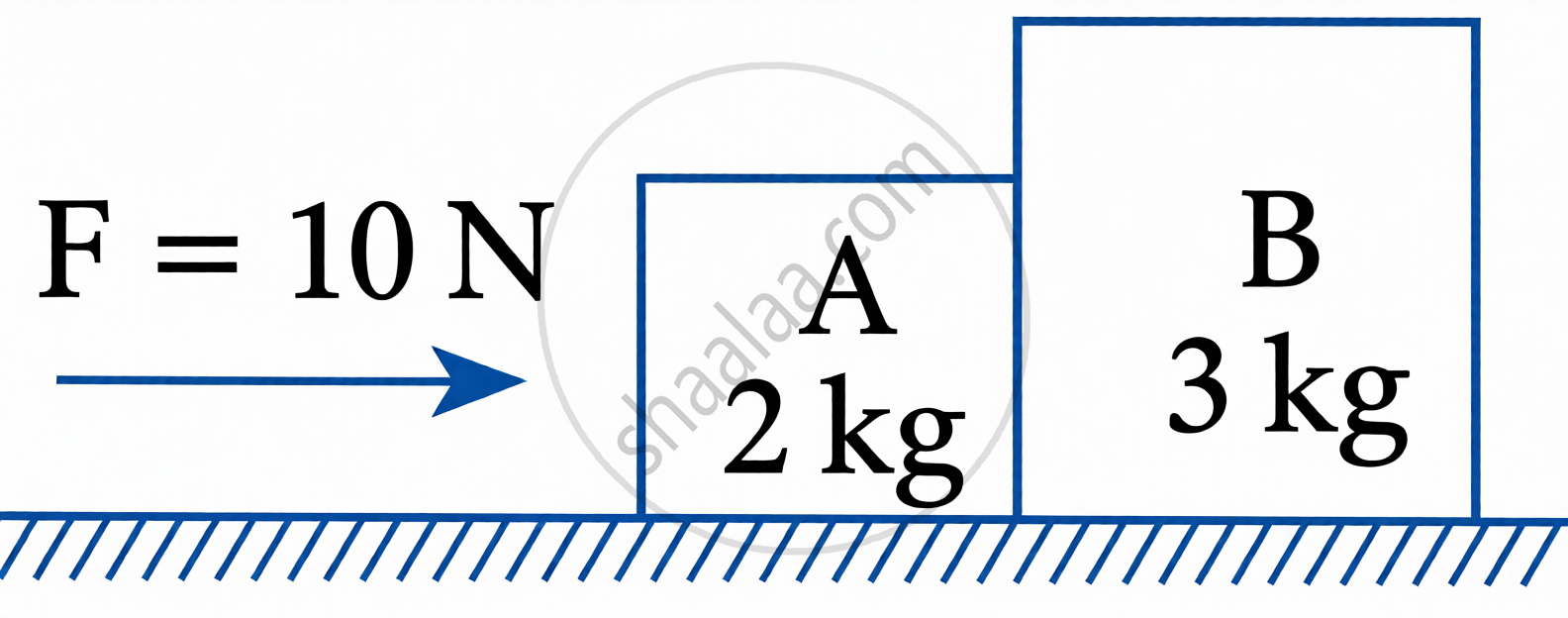
A horizontal force 10 N is applied to a block A as shown in figure. The mass of blocks A and B are 2 kg and 3 kg, respectively. The blocks slide over a frictionless surface. The force exerted by block A on block B is: