Advertisements
Advertisements
प्रश्न
Explain the formation of clouds at high altitude.
Advertisements
उत्तर
- Clouds arise when air contains all of the water vapours (gas) that it can hold. This is known as the saturation point, and it can be attained in two ways.
- First, moisture accumulates till it reaches the maximum volume of air that it can contain.
- The other way lowers the temperature of the moisture-filled air, so lowering the quantity of moisture it can hold.
- As a result, saturation is achieved through evaporation and condensation.
- When moisture reaches saturation, it manifests as visible water droplets in the form of fog and clouds.
APPEARS IN
संबंधित प्रश्न
If the frequency of incident light falling on a photosensitive material is doubled, then the kinetic energy of the emitted photoelectron will be ______.
Can microwaves be used in the experiment on photoelectric effect?
Using the values of work function given in the following table, tell which metal will require the highest frequency of incident radiation to generate photocurrent.
Typical values of work function for some common metals
| Metal | Work function (in eV) |
| Potassium | 2.3 |
| Sodium | 2.4 |
| Calcium | 2.9 |
| Zinc | 3.6 |
| Silver | 4.3 |
| Aluminium | 4.3 |
| Tungsten | 4.5 |
| Copper | 4.7 |
| Nickel | 5.0 |
| Gold | 5.1 |
The threshold wavelength of tungsten is 2.76 x 10⁻⁵ cm.
(a) Explain why no photoelectrons are emitted when the wavelength is more than 2.76 x 10⁻⁵ cm.
(b) What will be the maximum kinetic energy of electrons ejected in each of the following cases
(i) if ultraviolet radiation of wavelength λ = 1.80 × 10⁻⁵ cm and
(ii) radiation of frequency 4 x 10¹⁵ Hz is made incident on the tungsten surface?
The maximum kinetic energy of the photoelectrons depends only on ______
Define photoelectric effect.
Find the energy of photon which have momentum 2 × 10-16 gm-cm/sec.
If the total energy of radiation of frequency 1014 Hz is 6.63 J, Calculate the number of photons in the radiation.
State Einstein photoelectric equation.
The energy of a photon is 2 eV. Find its frequency and wavelength.
The maximum velocity of the photoelectron emitted by the metal surface is v. Charge and the mass of the photoelectron is denoted by e and m, respectively. The stopping potential in volt is ______.
The maximum velocity of photoelectron emitted is 4.8 m/s. If the e/m ratio of the electron is 1.76 × 10¹¹ C/kg, then stopping potential is given by ______
The following graph shows the stopping potential V0 versus frequency v for photoelectric emission from two metals A and B. The slope of each of the lines gives ______

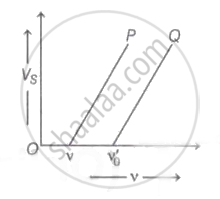
The graph of stopping potential `"V"_"s"` against frequency v of incident radiation is plotted for two different metals P and Q as shown in the graph. ΦP and ΦQ are work-functions of P and Q respectively, then
If the maximum kinetic energy of emitted electrons in photoelectric effect is 3.2 × 10⁻¹⁹ J and the work-function for metal is 6.63 × 10⁻¹⁹ J, then stopping potential and threshold wavelength respectively are
[Planck's constant, h = 6.63 × 1034 J-s]
[Velocity of light, c = 3 × 10⁸ `"m"/"s"`]
[Charge on electron= 1.6 × 10⁻¹⁹ C]
The work function of a metallic surface is 5.01 eV. The photoelectrons are emitted when light of wavelength 2000 Å falls on it. The potential difference applied to stop the fastest photoelectrons is [h = 4.14 x 10⁻¹⁵ eV sec] ____________.
Light of frequency 2 times the threshold frequency is incident on a photo sensitive material. If the frequency is made `1/3`rd and intensity is doubled then the photocurrent will ______.
The work function of a substance is 4.0 eV. The longest wavelength of light that can cause photo-emission from this substance is approximately (h = 6.63 × 10⁻³⁴ Js)[1eV = 1.6 × 10⁻¹⁹ J]
The photon of frequency vis incident on a metal surface whose threshold frequency is v0. The kinetic energy of the emitted photoelectrons will be ______.
Two incident radiations having energies two times and ten times of the work function of a metal surface, produce photoelectric effect. The ratio of maximum velocities of emitted photo electrons respectively is ____________.
The stopping potential in the context of photoelectric effect depends on the following property of incident electromagnetic radiation ______.
The maximum kinetic energy of the photoelectrons ejected will be ______ eV when the light of wavelength 350 nm is incident on a cesium surface. The work function of cesium = 1.9 eV.
On a photosensitive material when frequency of incident radiation is increased by 30%, kinetic energy of emitted photoelectrons increases from 0.4 eV. The work function of the surface is ______.
Light of two different frequencies whose photons have energies 1.3 eV and 2.8 eV respectively, successfully illuminate a metallic surface whose work function is 0.8 eV. The ratio of maximum speeds of emitted electrons will be ______.
Draw a neat labelled diagram of photo-current as a function of accelerating potential for fixed incident intensity but different incident frequencies for the same emitter material.
The threshold frequency for a certain metal for photoelectric effect is 1.7 x 10¹⁵ Hz. When a light of frequency 2.2 x 10¹⁵ Hz is incident on the metal surface, the kinetic energy of the emitted photoelectrons is 3.3 x.10-19 J. Calculate Planck's constant.
According to Einstein's photoelectric equation, the graph of kinetic energy of the photoelectron emitted from the metal versus the frequency of incident radiation gives a straight line graph whose slopе ______.
