Advertisements
Advertisements
प्रश्न
Explain the following term with an example.
Oxidant
Advertisements
उत्तर
The substances which can give oxygen to other substance are called oxidants or oxidizing agents.
E.g. Potassium permanganate (KMnO4) and potassium dichraomate (K2Cr2O7) in acidic or alkaline medium are commonly used oxidants.
APPEARS IN
संबंधित प्रश्न
While studying saponification reaction, a student measures the temperature of the reaction mixture and also finds its nature using blue/red litmus paper. On the basis of his observations the correct conclusion would be
(A) the reaction is exothermic and the reaction mixture is acidic.
(B) the reaction is endothermic and the reaction mixture is acidic.
(C) the reaction is endothermic and the reaction mixture is basic.
(D) the reaction is exothermic and the reaction mixture is basic.
A student adds a spoon full of powdered sodium hydrogen carbonate to a flask containing ethanoic acid. List two main observations, he must note in his note book, about the reaction that takes place. Also write chemical equation foe the reaction.
When zinc powder is added to acetic acid ______________
(a) the mixture becomes warm
(b) a gas is evolved
(c) the colour of the mixture becomes yellow
(d) a solid settles at the bottom
Write the formula of ethanoic acid.
How would you distinguish experimentally between an alcohol and a carboxylic acid on the basis of a chemical property?
Choose those compounds from the following which can turn blue litmus solution red:
HCHO, CH3COOH, CH3OH, C2H5OH, HCOOH, CH3CHO
Give reasons for your choice.
Name two oxidising agents which can oxidise ethanol to ethanoic acid.
An organic compound A (molecular formula C2H4O2) reacts with Na metal to form a compound B and evolves a gas which burns with a pop sound. Compound A on treatment with an alcohol C in the presence of a little of concentrated sulphuric acid forms a sweet-smelling compound D (molecular formula C3H6O2). Compound D on treatment with NaOH solution gives back B and C. Identify A, B, C and
Write the IUPAC name of the following:
\[\begin{array}{cc}
\ce{CH3}\\
|\\
\ce{CH3 -C -CH3}\\
|\\
\ce{CH3}
\end{array}\]
Name the substance used to change acetic acid to acetic anhydride?
What do you observe when acetic acid is added to sodium bicarbonate?
A student puts a drop of acetic acid first on a blue litmus paper and then on a red litmus paper. He would observe that
(A) the red litmus paper turns colourless and there is no change in the blue litmus paper.
(B) the red litmus paper turns blue and the blue litmus paper turns red.
(C) there is no change in the red litmus paper and the blue litmus paper turns red.
(D) there is no change in the blue litmus paper and the red litmus paper turns blue.
Which of the following observations is true about dilute solution of acetic acid?
(A) It smells like vinegar and turns red litmus blue
(B) It smells like onion and turns blue litmus red
(C) It smells like orange and turns red litmus blue
(D) It smells like vinegar and turns blue litmus red
What type of compound is formed by the reaction between acetic acid and an alcohol?
Rewrite the following statement by selecting the correct option.
The formula of ethanoic acid is _____________.
Write the characteristics of ethanoic acid.
Write the answers to the questions by observing the following figure.
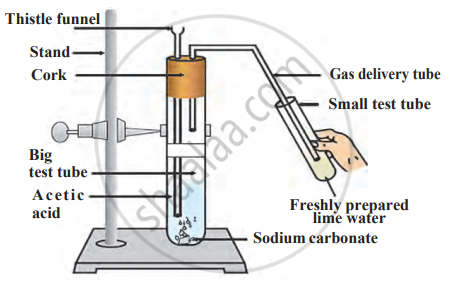
- Write the chemical reaction shown in the figure above in the form of a balanced equation.
- Write the name of the gas coming out of the large test tube in the above chemical reaction.
- Why do small bubbles of lime appear in the small test tube?
- What is the change in colour of lime net?
Ester is formed by the reaction between ______.
Reshu by mistake forgot to label the two test tubes containing Ethanol and Ethanoic acid. Suggest an experiment to identify the substances correctly? Illustrate the reactions with the help of chemical equations.
How is ethanol to ethanoic acid an oxidation reaction different from the reaction in which ethanol burns in the presence of oxygen?
