Advertisements
Advertisements
प्रश्न
Explain the following reaction with the balanced equation.
Zinc oxide is treated with carbon
Advertisements
उत्तर
Zinc oxide is reduced to zinc by heating it with carbon.
\[\ce{\underset{\text{Zinc oxide}}{ZnO_{(s)}} + \underset{\text{Carbon}}{C_{(s)}} ->[Heat] \underset{\text{Zinc}}{Zn_{(s)}} + \underset{\text{Carbon monoxide}}{CO↑}}\]
APPEARS IN
संबंधित प्रश्न
Which metal becomes black in the presence of hydrogen sulphide gas in air?
Why does a new aluminium vessel lose shine so soon after use?
Which gas is produced during the extraction of aluminium? At which electrode is this gas produced?
An important ore of zinc metal is ______.
Metals X and Y can be recovered from the anode mud left behind after the electrolytic refining of copper metal. The coins made of metal X look new even after several years of use but the coins made of metal Y lose their shine gradually and get blackened soon. When metal X is alloyed with a small amount of metal Y, it becomes hard and hence suitable for making ornaments. What are metals X and Y? Also state the colour of metal X.
Give the principles of the froth floatation process.
Give reasons, why aluminum is used in:
painting electric and telegraphic poles
Which method of refining is used to get 99.8% pure aluminium?
Complete the incomplete statement with missing word:
Non-metals form acidic oxides while metals form ______.
Froth floatation process is generally used to concentrate ______ ores.
Observe the given figure of reactivity series of metals and answer the following questions:
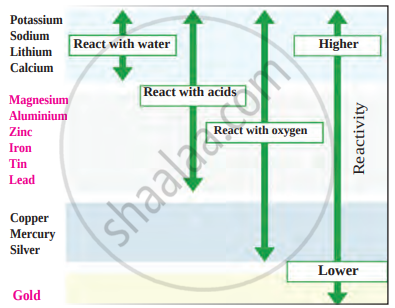
Reactivity series of metals
- Name two metals which react with water.
- Name two moderately reactive metals.
- Name the most highly reactive metal and the most less reactive metal.
_______ is the least reactive metal.
Zinc sulphide : Roasting : : zinc carbonate : _______
Write the name.
Strongly heating carbonate ores in insufficient air -
Explain the following reaction with the balanced equation.
Zinc carbonate is heated strongly in limited supply of air
Observe the figure and answer the following.
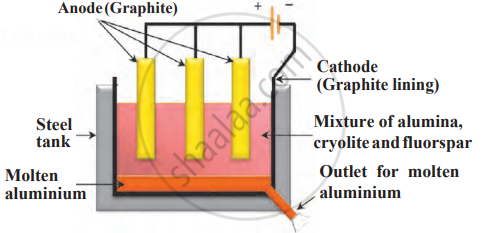
- Write the name of the method.
- What is used as anode and cathode in this method?
- Write the molecular formula and use of cryolite.
- Write anode reaction.
- Write cathode reaction.
Explain the difference between Bayer’s process and Hall’s process by explaining the Bayer’s process.
Oxides of moderately reactive metals like Zinc, Iron, Nickel, Tin, Copper, etc. are reduced by using:
On the basis of reactivity metals are grouped into three categories:
- Metals of low reactivity
- Metals of medium reactivity
- Metals of high reactivity
Therefore metals are extracted in pure form from their ores on the basis of their chemical properties.
Metals of high reactivity are extracted from their ores by electrolysis of the molten ore.
Metals of low reactivity are extracted from their sulphide ores, which are converted into their oxides. The oxides of these metals are reduced to metals by simple heating.
(a) Name the process of reduction used for a metal that gives vigorous reaction with air and water both.
(b) Carbon cannot be used as a reducing agent to obtain aluminium from its oxide? Why?
(c) Describe briefly the method to obtain mercury from cinnabar. Write the chemical equation for the reactions involved in the process.
OR
(c) Differentiate between roasting and calcination giving chemical equation for each.
