Advertisements
Advertisements
प्रश्न
Explain any four features of perfect competition.
Explain the perfect competition’s three characteristics.
Describe any three characteristics of perfect competition.
What are the characteristics of a perfectly competitive market?
Give two characteristics of perfect competition.
Mention one feature of a perfect market.
State two features of perfect competition.
Give two features of perfect competition.
Explain one feature of perfect competition.
Explain the characteristics of perfect competition.
Give any four features of a perfectly competitive market.
Give the main features of perfect market.
State and explain any three characteristics of perfect competition market.
Mention two features of perfect competition.
Advertisements
उत्तर १
- Large Number of Buyers and Sellers: The market price cannot be influenced by any single buyer or seller because of the large number of participants. Each firm contributes so little to overall output that changes in supply have little effect on market price. Similarly, individual buyers cannot impact demand. As a result, each firm is a price taker.
- Homogeneous Product: All firms offer identical or completely interchangeable items. There is no difference in quality, brand, or features, and purchasers are indifferent about the seller. As a result, a uniform pricing prevails in the market because no firm can charge more than another.
- Free Entry and Exit: Firms have the freedom to enter and exit the market without any legal, financial, or technical barriers. If firms make excessive profits, more firms enter the market, increasing supply and driving down prices. Firms that incur losses exit the market, reducing supply and raising prices. This system ensures that profits remain typical in the long run.
- Perfect mobility: Land, labour, and capital can freely flow between enterprises and industries. This mobility ensures that resources are allocated efficiently by shifting them to the most productive locations. It also promotes the entry and exit of enterprises.
- Perfect Knowledge: Buyers and sellers have complete knowledge about product prices, quality, and market conditions. No business may charge more than the market price, and customers will not pay more than necessary. Firms also understand the most efficient production procedures, resulting in similar cost structures.
- Absence of Selling Cost: Assuming no transportation costs, the price is constant for all buyers, regardless of location. If transportation expenses didn’t exist, retailers closer to the buyer could charge less. This assumption contributes to a market-wide price uniformity.
उत्तर २
- Large Number of Buyers and Sellers: Under perfect competitions, there are large number of sellers and buyers. As mentioned earlier, each seller forms a negligible part in the total market. Hence, none of them is in a position to influence the price and supply in the market. Thus, sellers are price takers under perfect competition.
The number of buyers is also large. The share of each buyer is so negligible that none of them is in a position to influence the price in the market. - Homogeneous product: An important feature of a perfectly competitive market is that the product sold is homogeneous or identical in respect of size, design, colour, taste etc. All the products are perfect substitutes to each other.
- Free entry and exit: There are no barriers to the entry and exit of firms. Any firm can enter or quit the industry at its own will. If there is hope of profit, the firm will enter the market and if there is possibility of loss the firm will leave the market.
- Single price: A single uniform price prevails under perfect competition which is determined by the interaction of demand and supply.
- Perfect knowledge of market: The buyers and sellers possess a perfect knowledge about the market conditions. Every seller and buyer has the knowledge about price, quality, source of supply of products, etc.
- Perfect mobility of factors of production: There is perfect mobility of factors of production under perfect competition. Labour and capital are mobile not only geographically but also occupationally
- Absence of transport cost: In perfect competition, the price is uniform because we assume that transport cost does not exist. This assumption will lead to uniformity in price.
- No government intervention: Laissez-faire policy is an important feature of perfect competition. It means there is absence of Government intervention in economic activities.
Notes
Students should refer to the answer according to their question and preferred marks.
APPEARS IN
संबंधित प्रश्न
Discuss any two features of a monopolistically competitive market.
Define Discriminating Monopoly.
Identify the market having a single buyer and many sellers from the following:
When products are differentiated on the basis of advertisements, brand names etc., it is called as ______.
In which type of market price discrimination is practiced? Explain with an example.
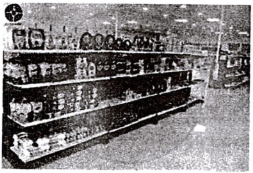
The image above shows a departmental store of a market structure.
- Identify the form of market as observed from the above image.
- Discuss the features of this market form with respect to:
- Type of product
- Entry and exit of firms
- Selling cost
Explain three features of Perfect competitive market.
What is the shape of the demand curve faced by any monopoly firm? Support your answer with a diagram.

“While shopping for fruits in the local market you see many seller selling fruits”. In this context answer the following:
- What is the type of market referred to?
- State and draw the type of demand curve faced by the market above.
- Differentiate between the market indicated above and monopoly on the basis of:
- No. of sellers
- Market price
- Entry and exit of firms in the market
Following is the feature of perfect competition:
Following is not the feature of perfect competition:
Differentiated products is a characteristic of ______.
'A few big sellers' is a characteristic of ______.
In monopolistic competition, there are ______.
Indian Railways is an example of ______.
A monopolist is price maker:
Indian Oil Corporation Limited is an example of a/an ______.
There is no difference between perfect competition and pure competition.
Match the following and select the correct option.
| Column I | Column II | ||
| (i) | Perfectly elastic demand | (A) | Oligopoly |
| (ii) | Less elastic demand | (B) | Monopolistic competition |
| (iii) | More elastic demand | (C) | Perfect competition |
| (iv) | Indeterminate demand | (D) | Monopoly |
"The price of a product under perfect competition is determined by an individual seller."
A market where homogeneous products are sold with no control over price by an individual firm or a buyer is ______.
The seller in a monopoly market is a price maker.
Which among the following is a feature of monopsony market?
The monopolist's downward sloping demand curve means that it can increase sales only by changing a lower price.
Which of the following market types has the fewest number of firms?
Identify the market form for seller A on the basis of the following information:
| Units of output sold | Price offered by seller A in ₹ |
| 30 | 10 |
| 40 | 10 |
| 50 | 10 |
Which one of the following is NOT found in a perfectly competition market?
The market structure which is characterised by a single producer of a commodity and when there are not close substitutes for that commodity:
A holiday resort in a remote village is very popular among the tourists. Since the connectivity is very poor with the outer world, the owner employs the local villagers for the functioning of the resort.
This is a case of:
Match the following:
| Column I | Column II | ||
| A. | Demand curve under perfect competition | (i) | Indeterminate demand curve |
| B. | Demand curve under monopoly | (ii) | Downward sloping but less elastic |
| C. | Demand curve under monopolistic competition | (iii) | Horizontal straight line |
| D. | Demand curve under oligopoly | (iv) | Elastic demand curve |
Read the following statements carefully and choose the correct alternative:
Assertion (A): Price discrimination is possible under monopoly.
Reason (R): A monopolist can charge different prices in different markets because different sets of consumers - rich and poor - have different price elasticity of demand for the monopolist's product.
Read the following statements carefully and choose the correct alternative:
Assertion (A): Buyers are ready to pay different prices for the product produced by different firms under perfect competition.
Reason (R): The products offered for sale in the perfect market are homogeneous.
Read the following statements carefully and choose the correct alternative:
Assertion (A): Under Perfect Competition, each firm faces a perfectly elastic demand curve.
Reason (R): Firm is a price maker under perfect competition.
What is meant by pure competition?
Producers in a monopoly are price makers. Briefly explain.
Give three points of difference between perfect competition and monopoly.
Define monopolistic competition.
Define monopsony.
State two important characteristics of monopoly.
Define product differentiation.
Highlight the importance of selling costs in a monopolistically compatible market.
In which form of market is the seller a price taker? Justify your answer.
Identify the market form of the following:
The Government of India is the sole buyer of fighter aircrafts.
Identify the market form of the following:
Motor car market in India.
Identify the market form for the following:
Railways in India.
Identify the market form for the following:
Textile industry in India.
Identify the market form for the following:
Perfectly elastic demand.
Identify the market form for the following:
Telecom industry in India.
State the market form of the following commodity.
Shampoos
State the market form of the following commodity.
Fighter Aircrafts
Identify the market form for the item given below:
Product differentiation
Discuss any four differences between monopoly and monopolistic competition.
Which type of market structure is the following? Give reason.
Mobile phone services
Which type of market structure is the following? Give reason.
Lipstick
Which type of market structure is the following? Give reason.
Ball-pen
Monopolistic competition is the perfect blending of monopoly and perfect competition. Explain.
With the help of an example explain the meaning of price discrimination.
Why can a monopolist charge different prices in different markets?
To which market form are homogeneous products relevant?
What is meant by barriers to entry?
What is the effect on price when a perfectly competitive firm tries to sell more?
What is the difference between perfect and imperfect oligopoly?
What is the difference between collusive and non-collusive oligopoly?
Elaborate the price discrimination feature of monopoly.
Identify the market form from the following.
Firm is a price maker.
Identify the market form from the following:
A few large sellers
There is inverse relation between price and demand for the product of a firm under ______.
Mention one feature of a monopoly market.
Name the characteristic which makes monopolistic competition different from perfect competition.
What is a price making firm?
Why are selling costs incurred?
In which market form is there a single seller and no close substitutes for the product?
Which feature best distinguishes monopolistic competition from perfect competition?
In which type of market are firms interdependent and a few large firms dominate?
