Advertisements
Advertisements
प्रश्न
In which form of market is the seller a price taker? Justify your answer.
In which market form the firm is price taker?
“Under which type of a market are producers price takers?”
Under which market form a firm is a price-taker?
Advertisements
उत्तर
- In a perfectly competitive market, the seller is a price taker.
- In perfect competition, there are many sellers and purchasers in the market, and all firms sell identical (homogeneous) products. Because each firm’s output is small in comparison to the entire market supply, no single seller can influence market price.
- Because all businesses sell the same commodities, no company can differentiate its product sufficiently to demand a higher price, requiring every seller to be a price taker.
Notes
Students should refer to the answer according to the question.
APPEARS IN
संबंधित प्रश्न
Discuss any two features of a monopolistically competitive market.
Define Discriminating Monopoly.
Which two forms of market earn normal profit in the long run?
Identify the market having a single buyer and many sellers from the following:
Selling costs are absent in perfect competition market.
What is the shape of the demand curve faced by any monopoly firm? Support your answer with a diagram.
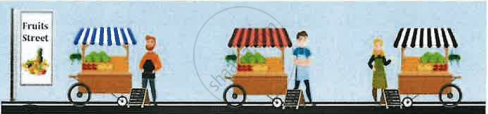
“While shopping for fruits in the local market you see many seller selling fruits”. In this context answer the following:
- What is the type of market referred to?
- State and draw the type of demand curve faced by the market above.
- Differentiate between the market indicated above and monopoly on the basis of:
- No. of sellers
- Market price
- Entry and exit of firms in the market
Indian Railways is an example of ______.
Indian Oil Corporation Limited is an example of a/an ______.
"The price of a product under perfect competition is determined by an individual seller."
The seller in a monopoly market is a price maker.
Identify the market form for seller A on the basis of the following information:
| Units of output sold | Price offered by seller A in ₹ |
| 30 | 10 |
| 40 | 10 |
| 50 | 10 |
Products sold by each firm in a perfectly competitive market are perfect substitutes of each other.
A holiday resort in a remote village is very popular among the tourists. Since the connectivity is very poor with the outer world, the owner employs the local villagers for the functioning of the resort.
This is a case of:
Match the following:
| Column I | Column II | ||
| A. | Monopoly | (i) | Availability of close substitutes |
| B. | Oligopoly | (ii) | Absence of close substitutes |
| C. | Perfect competition | (iii) | Few large sellers |
| D. | Monopolistic competition | (iv) | Homogeneous products |
Read the following statements carefully and choose the correct alternative:
Assertion (A): Price discrimination is possible under monopoly.
Reason (R): A monopolist can charge different prices in different markets because different sets of consumers - rich and poor - have different price elasticity of demand for the monopolist's product.
What is meant by pure competition?
Give an example of oligopoly.
Give two characteristics of perfect competition.
Identify the market form of the following:
Motor car market in India.
Identify the market form for the following:
Textile industry in India.
State the market form of the following commodity.
Automobiles
Identify the market form for the item given below:
A single seller
Give an example of monopoly.
Discuss any four differences between monopoly and monopolistic competition.
Which type of market structure is the following? Give reason.
Scooters
To which market is price discrimination relevant?
Give two examples of a monopolistically competitive market.
What do you mean by homogeneous products?
What is the effect on price when a perfectly competitive firm tries to sell more?
What does perfectly elastic demand curve faced by a competitive firm indicate?
Mention one feature of a monopoly market.
What is a price making firm?
Which feature best distinguishes monopolistic competition from perfect competition?
In which type of market are firms interdependent and a few large firms dominate?
Which statement correctly describes monopsony?
