Advertisements
Advertisements
प्रश्न
State the market form of the following commodity.
Railways
Advertisements
उत्तर
The market form of railways is a monopoly.
संबंधित प्रश्न
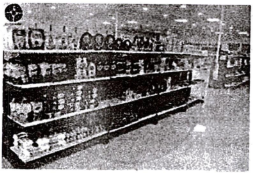
The image above shows a departmental store of a market structure.
- Identify the form of market as observed from the above image.
- Discuss the features of this market form with respect to:
- Type of product
- Entry and exit of firms
- Selling cost
Following is the feature of perfect competition:
Differentiated products is a characteristic of ______.
'A few big sellers' is a characteristic of ______.
In monopolistic competition, there are ______.
Indian Oil Corporation Limited is an example of a/an ______.
Which of these feature's is found in both a perfectly competitive market and a monopolistically competitive market?
Products sold by each firm in a perfectly competitive market are perfect substitutes of each other.
Match the following:
| Column I | Column II | ||
| A. | Demand curve under perfect competition | (i) | Indeterminate demand curve |
| B. | Demand curve under monopoly | (ii) | Downward sloping but less elastic |
| C. | Demand curve under monopolistic competition | (iii) | Horizontal straight line |
| D. | Demand curve under oligopoly | (iv) | Elastic demand curve |
Read the following statements carefully and choose the correct alternative:
Assertion (A): Under Perfect Competition, each firm faces a perfectly elastic demand curve.
Reason (R): Firm is a price maker under perfect competition.
Identify the market form of the following:
Motor car market in India.
Identify the market form for the following:
Textile industry in India.
Name the market in which there is a single buyer and many sellers. Give an example.
Give an example of monopoly.
Give an example of price discrimination.
Which type of market structure is the following? Give reason.
Jeans
Why can a monopolist charge different prices in different markets?
What induces new firms to enter an industry?
Identify the market form from the following:
A few large sellers
There is inverse relation between price and demand for the product of a firm under ______.
