Advertisements
Advertisements
प्रश्न
Evaluate:
`sec26^@ sin64^@ + (cosec33^@)/sec57^@`
Advertisements
उत्तर
`sec26^@ sin64^@ + (cosec33^@)/sec57^@`
= `sec(90^@-64^@)sin64^@ + (cosec(90^@-57^@))/sec57^@`
= `cosec64^@sin64^@ + sec57^@/sec57^@`
= 1 + 1
= 2
संबंधित प्रश्न
Solve.
`cos22/sin68`
Show that : sin 42° sec 48° + cos 42° cosec 48° = 2
Evaluate:
3cos80° cosec10° + 2 sin59° sec31°
Evaluate:
cos 40° cosec 50° + sin 50° sec 40°
Given
\[\frac{4 \cos \theta - \sin \theta}{2 \cos \theta + \sin \theta}\] what is the value of \[\frac{{cosec}^2 \theta - \sec^2 \theta}{{cosec}^2 \theta + \sec^2 \theta}\]
If \[\frac{{cosec}^2 \theta - \sec^2 \theta}{{cosec}^2 \theta + \sec^2 \theta}\] write the value of \[\frac{1 - \cos^2 \theta}{2 - \sin^2 \theta}\]
In the following figure the value of cos ϕ is
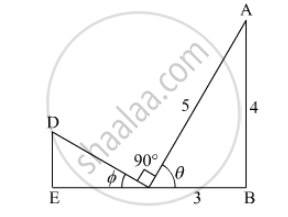
Prove the following.
tan4θ + tan2θ = sec4θ - sec2θ
`tan 47^circ/cot 43^circ` = 1
The value of the expression (cos2 23° – sin2 67°) is positive.
