Advertisements
Advertisements
प्रश्न
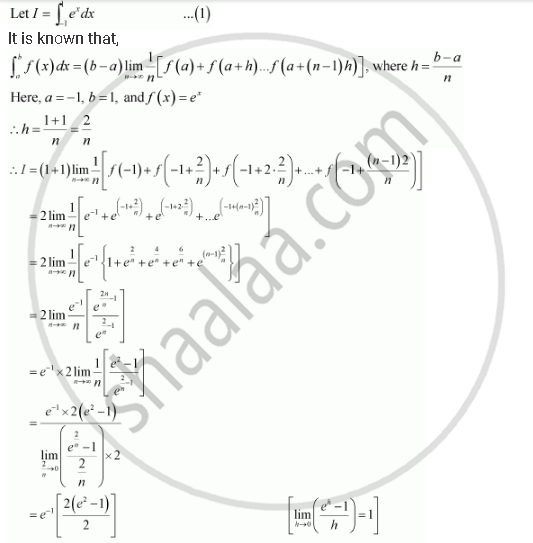
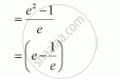
Evaluate the following definite integrals as limit of sums `int_(-1)^1 e^x dx`
Advertisements
उत्तर
APPEARS IN
संबंधित प्रश्न
Evaluate the following definite integrals as limit of sums.
`int_0^5 (x+1) dx`
Evaluate the following definite integrals as limit of sums.
`int_1^4 (x^2 - x) dx`
Evaluate the definite integral:
`int_(pi/2)^pi e^x ((1-sinx)/(1-cos x)) dx`
Evaluate the definite integral:
`int_0^(pi/2) sin 2x tan^(-1) (sinx) dx`
Evaluate the definite integral:
`int_1^4 [|x - 1|+ |x - 2| + |x -3|]dx`
Prove the following:
`int_1^3 dx/(x^2(x +1)) = 2/3 + log 2/3`
Prove the following:
`int_0^1 xe^x dx = 1`
Prove the following:
`int_0^(pi/2) sin^3 xdx = 2/3`
Choose the correct answers The value of `int_0^1 tan^(-1) (2x -1)/(1+x - x^2)` dx is
(A) 1
(B) 0
(C) –1
(D) `pi/4`
\[\int\frac{1}{x} \left( \log x \right)^2 dx\]
Evaluate the following integrals as limit of sums:
\[\int\frac{\sqrt{\tan x}}{\sin x \cos x} dx\]
Evaluate:
`int (sin"x"+cos"x")/(sqrt(9+16sin2"x")) "dx"`
Evaluate the following as limit of sum:
`int_0^2 "e"^x "d"x`
Evaluate the following:
`int_0^1 (x"d"x)/sqrt(1 + x^2)`
Evaluate the following:
`int_0^pi x sin x cos^2x "d"x`
Evaluate the following:
`int_(pi/3)^(pi/2) sqrt(1 + cosx)/(1 - cos x)^(5/2) "d"x`
The value of `int_(-pi)^pi sin^3x cos^2x "d"x` is ______.
The value of `lim_(x -> 0) [(d/(dx) int_0^(x^2) sec^2 xdx),(d/(dx) (x sin x))]` is equal to
If f" = C, C ≠ 0, where C is a constant, then the value of `lim_(x -> 0) (f(x) - 2f (2x) + 3f (3x))/x^2` is
Left `f(x) = {{:(1",", "if x is rational number"),(0",", "if x is irrational number"):}`. The value `fof (sqrt(3))` is
What is the derivative of `f(x) = |x|` at `x` = 0?
`lim_(n→∞){(1 + 1/n^2)^(2/n^2)(1 + 2^2/n^2)^(4/n^2)(1 + 3^2/n^2)^(6/n^2) ...(1 + n^2/n^2)^((2n)/n^2)}` is equal to ______.
`lim_(n rightarrow ∞)1/2^n [1/sqrt(1 - 1/2^n) + 1/sqrt(1 - 2/2^n) + 1/sqrt(1 - 3/2^n) + ...... + 1/sqrt(1 - (2^n - 1)/2^n)]` is equal to ______.
