Advertisements
Advertisements
प्रश्न
Draw the circuit diagram of an illuminated photodiode in reverse bias. How is photodiode used to measure light intensity?
Advertisements
उत्तर
The circuit diagram of an illuminated photodiode in reverse bias can be represented as
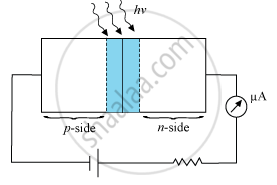
The greater the intensity of light, the greater is the number of photons falling per second per unit area. Thus, the greater the intensity of light, the greater is the number of electron−hole pairs produced at the junction. The photocurrent is, thus, directly proportional to the intensity of light. This can be used for measuring the intensity of incident light.
APPEARS IN
संबंधित प्रश्न
The width of depletion region of p-n junction diode is _______.
(A) 0.5 nm to 1 nm
(B) 5 nm to 10 nm
(C) 50 nm to 500 nm
(D) 500 nm to 1000 nm
State its any ‘two’ uses of photodiode.
Why is zener diode fabricated by heavily doping both p- and n-sides of the junction?
An ideal diode should pass a current freely in one direction and should stop it completely in the opposite direction. Which is closer to ideal-vacuum diode or a p-njunction diode?
Explain photodiode.
Pressure P varies as P = `alpha/beta "exp" (- (alpha x)/"k"_"BT")`, where x denotes the distance, kB is the Boltzmann's constant, T is the absolute temperature and α and β are constant. The dimension of β is ______.
In Figure, assuming the diodes to be ideal ______.

Briefly explain how emf is generated in a solar cell.
Draw solar cells of I-V characteristics.
What energy conversion takes place in a solar cell?
