Advertisements
Advertisements
प्रश्न
Do you think it is good to be a rebel?
Advertisements
उत्तर
No, to go against the flow just to show that you are different or to prove your superiority is Wrong. Unnecessarily breaking the rule unless there is some noble cause is not acceptable.
संबंधित प्रश्न
Answer these question in a few words or a couple of sentence.
Had Margie ever seen a book before?
Answer the question in a short paragraph.
What is the belief at Pashupatinath about the end of Kaliyug?
Thinking about Poem
How has the tree grow to its full size? List the words suggestive of its life and activity.
“Toto was a pretty monkey.” In what sense is Toto pretty?
The next man looking 'cross the way
Saw one not of his church
And Couldn't bring himself to give
The fire his stick of birch.
The third one sat in tattered clothes.
He gave his coat a hitch.
Why should his log be put to use
To warm the idle rich?
The rich man just sat back and thought
of the wealth he had in store
And how to keep what he had earned
From the lazy shiftless poor.
Read the lines given above and answer the question that follow.
Explain with reference to context
The next man looking 'cross the way
Saw one not of his church
And Couldn't bring himself to give
The fire his stick of birch.
The third one sat in tattered clothes.
He gave his coat a hitch.
Why should his log be put to use
To warm the idle rich?
The rich man just sat back and thought
of the wealth he had in store
And how to keep what he had earned
From the lazy shiftless poor.
Read the lines given above and answer the question that follow.
To what purpose are the symbol words used repeatedly?
Of the seven hundred villages dotting the map of India, in which the majority of India’s five hundred million live, flourish and die, Kritam was probably the tiniest, indicated on the district survey map by a microscopic dot, the map being meant more for the revenue official out to collect tax than for the guidance of the motorist, who in any case could not hope to reach it since it sprawled far from the highway at the end of a rough track furrowed up by the iron-hooped wheels of bullock carts. But its size did not prevent its giving itself the grandiose name Kritam, which meant in Tamil coronet or crown on the brow of the subcontinent. The village consisted of fewer than thirty houses, only one of them built from brick and cement and painted a brilliant yellow and blue all over with
gorgeous carvings of gods and gargoyles on its balustrade, it was known as the Big House. The other houses, distributed in four streets, were generally of bamboo thatch, straw, mud and other unspecified material. Muni’s was the last house in the fourth street, beyond which stretched the fields. In his prosperous days Muni had owned a flock of sheep and goats and sallied forth every morning driving the flock to the highway a couple of miles away.
Read the extract given below and answer the question that follow.
Describe Muni’s prosperous days.
Read the extract given below and answer the questions that follow:
Each Friday morning the whole school spent the pre-recess period in writing their Weekly Review. This was one of the Old Man’s pet schemes; and one about which he would brook no interference. Each child would review the events of his school week in his own words, in his own way; he was free to comment, to criticize, to agree or disagree, with any person, subject or method, as long as it was in some way associated with the school …..
(i) Why did Mr. Florian feel that the weekly review was of advantage to both pupil and teacher?
(ii) Why did Braithwaite feel both relief and disappointment at the first weekly review his students had written since he joined the school?
(iii) How was he given the silent treatment by his students?
(iv) What does Braithwaite term the second and more annoying phase of his relationship with his students? What did some students do to disrupt his class?
(v) Mention two qualities in Braithwaite’s character which help him to become a model teacher. Give suitable examples to illustrate your choice.
How do the smaller desert animals fulfill their need for water?
Why the author called those boots bought from big firm ‘ill-omened’?
How old were Kari (the elephant) and the narrator?
Describe Mr. Purcell’s daily routine at the shop.
Why did the lady chain the bear on Sundays?
The monkey was happy living in the fruit tree, but his happiness was not complete, what did he miss?
What happens when we are asleep?
What sort of life did Dogs live a long time ago?
Multiple Choice Question:
What does the expression “They pinched the chocolate-flakes’ mean?
Multiple Choice Question:
How are thoughts like prisoners?
Look at the following picture. One asks a question, the other answers it. Then the answer is noted in a form as shown below.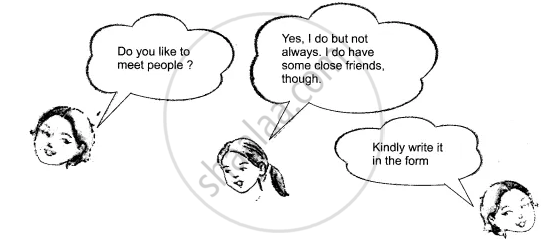
| Questions | Yes/No | Additional Response |
|
1. Do you like to meet people? |
Yes I do, but not always | I do have some close friends, though. |
|
2. Do you like the area you live in? |
No, I Don't | But I have no choice |
Complete the following sentence by providing a reason.
Beethoven amputated the legs of his piano because ______.
