Advertisements
Advertisements
प्रश्न
Determine the maximum value of Z = 4x + 3y if the feasible region for an LPP is shown in figure
Advertisements
उत्तर
The feasible region is bounded.
Therefore, maximum of Z must occur at the corner point of the feasible region (Figure)
| Corner Point | Value of Z | |
| O,(0, 0) | 4 (0) + 3 (0) = 0 | |
| A(25, 0) | 4 (25) + 3 (0) = 100 | |
| B(16, 16) | 4 (16) + 3 (16) = 112 | ← (Maximum) |
| C(0, 24) | 4 (0) + 3 (24) = 72 |
Hence, the maximum value of Z is 112.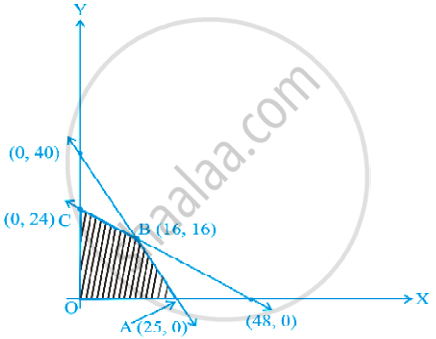
APPEARS IN
संबंधित प्रश्न
A rubber company is engaged in producing three types of tyres A, B and C. Each type requires processing in two plants, Plant I and Plant II. The capacities of the two plants, in number of tyres per day, are as follows:
| Plant | A | B | C |
| I | 50 | 100 | 100 |
| II | 60 | 60 | 200 |
The monthly demand for tyre A, B and C is 2500, 3000 and 7000 respectively. If plant I costs Rs 2500 per day, and plant II costs Rs 3500 per day to operate, how many days should each be run per month to minimize cost while meeting the demand? Formulate the problem as LPP.
A manufacturer can produce two products, A and B, during a given time period. Each of these products requires four different manufacturing operations: grinding, turning, assembling and testing. The manufacturing requirements in hours per unit of products A and B are given below.
| A | B | |
| Grinding | 1 | 2 |
| Turning | 3 | 1 |
| Assembling | 6 | 3 |
| Testing | 5 | 4 |
The available capacities of these operations in hours for the given time period are: grinding 30; turning 60, assembling 200; testing 200. The contribution to profit is Rs 20 for each unit of A and Rs 30 for each unit of B. The firm can sell all that it produces at the prevailing market price. Determine the optimum amount of A and B to produce during the given time period. Formulate this as a LPP.
A firm manufactures two products, each of which must be processed through two departments, 1 and 2. The hourly requirements per unit for each product in each department, the weekly capacities in each department, selling price per unit, labour cost per unit, and raw material cost per unit are summarized as follows:
| Product A | Product B | Weekly capacity | |
| Department 1 | 3 | 2 | 130 |
| Department 2 | 4 | 6 | 260 |
| Selling price per unit | Rs 25 | Rs 30 | |
| Labour cost per unit | Rs 16 | Rs 20 | |
| Raw material cost per unit | Rs 4 | Rs 4 |
The problem is to determine the number of units to produce each product so as to maximize total contribution to profit. Formulate this as a LPP.
An airline agrees to charter planes for a group. The group needs at least 160 first class seats and at least 300 tourist class seats. The airline must use at least two of its model 314 planes which have 20 first class and 30 tourist class seats. The airline will also use some of its model 535 planes which have 20 first class seats and 60 tourist class seats. Each flight of a model 314 plane costs the company Rs 100,000 and each flight of a model 535 plane costs Rs 150,000. How many of each type of plane should be used to minimize the flight cost? Formulate this as a LPP.
Objective function of a LPP is
Let X1 and X2 are optimal solutions of a LPP, then
The maximum value of Z = 4x + 2y subjected to the constraints 2x + 3y ≤ 18, x + y ≥ 10 ; x, y ≥ 0 is
The maximum value of Z = 4x + 3y subjected to the constraints 3x + 2y ≥ 160, 5x + 2y ≥ 200, x + 2y ≥ 80; x, y ≥ 0 is
Consider a LPP given by
Minimum Z = 6x + 10y
Subjected to x ≥ 6; y ≥ 2; 2x + y ≥ 10; x, y ≥ 0
Redundant constraints in this LPP are
Which of the following is not a convex set?
Choose the correct alternative:
The constraint that in a college there are more scholarship holders in FYJC class (X) than in SYJC class (Y) is given by
Choose the correct alternative:
How does a constraint, “A washing machine can hold up to 8 kilograms of cloths (X)” can be given?
State whether the following statement is True or False:
The half-plane represented by 3x + 4y ≥ 12 includes the point (4, 3)
Tyco Cycles Ltd manufactures bicycles (x) and tricycles (y). The profit earned from the sales of each bicycle and a tricycle are ₹ 400 and ₹ 200 respectively, then the total profit earned by the manufacturer will be given as ______
By spending almost ₹ 250, Rakhi bought some kg grapes (x) and some dozens of bananas (y), then as a constraint this information can be expressed by ______
Solve the following LPP graphically:
Maximise Z = 2x + 3y, subject to x + y ≤ 4, x ≥ 0, y ≥ 0
A manufacturing company makes two types of television sets; one is black and white and the other is colour. The company has resources to make at most 300 sets a week. It takes Rs 1800 to make a black and white set and Rs 2700 to make a coloured set. The company can spend not more than Rs 648000 a week to make television sets. If it makes a profit of Rs 510 per black and white set and Rs 675 per coloured set, how many sets of each type should be produced so that the company has maximum profit? Formulate this problem as a LPP given that the objective is to maximise the profit.
Minimise Z = 3x + 5y subject to the constraints:
x + 2y ≥ 10
x + y ≥ 6
3x + y ≥ 8
x, y ≥ 0
Feasible region (shaded) for a LPP is shown in the Figure Minimum of Z = 4x + 3y occurs at the point ______.
A type of problems which seek to maximise (or, minimise) profit (or cost) form a general class of problems called.
What is defined as a problem in which a linear objective function is to be maximised or minimised subject to a set of linear constraints and non-negative conditions on the variables?
An optimisation problem becomes a Linear Programming Problem (LPP) when:
What is the correct sequential order of steps to formulate and solve a 2-variable Linear Programming Problem?
A furniture dealer invests in tables (\[x\]) and chairs (\[y\]). He has \[\text{Rs } 50,000\] to invest and storage space for at most \[60\] pieces. A table costs \[\text{Rs } 2500\] and gives a profit of \[\text{Rs } 250\], while a chair costs \[\text{Rs } 500\] and gives a profit of \[\text{Rs } 75\]. What is the objective function to maximise total profit \[Z\]?
For a furniture dealer with an investment limit of \[\text{Rs } 50,000\] and space for at most \[60\] pieces, where a table costs \[\text{Rs } 2500\] and a chair costs \[\text{Rs } 500\], which set of inequalities correctly represents the investment and storage constraints (where \[x\] is tables and \[y\] is chairs)?
