Advertisements
Advertisements
प्रश्न
Describe Bohr's model of the atom. How did Neils Bohr explain the stability of atom?
Advertisements
उत्तर
Bohr's model of atom :
An atom is made up of three particles: electrons, protons, and neutrons.
(i) The protons and neutrons are located in a small nucleus at the centre of the atom.
(ii) The electrons revolve rapidly around the nucleus in fixed circular paths called energy levels or shells.
(iii) There is a limit to the number of electrons that each energy level can hold.
(iv) Each energy level is associated with a fixed amount of energy.
(v) There is no change in the energy of electrons as long as they keep revolving in the same energy level, and the atom remains stable.
Niels Bohr explained the stability of the atoms through the concept of revolution of electrons in different energy levels. The change in the energy of an electron occurs when it jumps from a lower energy level to a higher energy level or vice versa. When it gains energy, it jumps from a lower energy level to a higher energy level, and when it loses energy it comes down from a higher energy level to a lower energy level. In this way, energy is not lost and the atom remains stable.

A few energy levels in an atom.
APPEARS IN
संबंधित प्रश्न
Describe Bohr’s model of the atom.
Name the central part of an atom where protons and neutrons are held together.
State true or false. If false, correct the statement.
Smaller the size of the orbit, lower is the energy of the orbit.
Explain the postulates of Bohr’s atomic model.
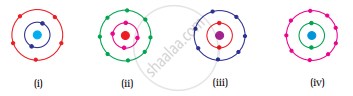
Which of the following in Fig. 4.2 do not represent Bohr’s model of an atom correctly?
Niels Bohr was Born on ______.
What are the Limitations of Bohr’s Model?
The atomic model based on quantum theory was first proposed by ______.
Bohr's model of atoms ______.
The scientist who proposed the atomic model based on the quantisation of energy for the first time is ______.
