Advertisements
Advertisements
प्रश्न
Deduce an expression for the frequency of revolution of a charged particle in a magnetic field and show that it is independent of velocity or energy of the particle.
Advertisements
उत्तर
When a charged particle with charge q moves inside a magnetic field `vecB`with velocity v, it experiences a force, which is given by:
`vecF=q(vecvxxvecB)`
Here, `vecv` is perpendicular to `vecB`,`vecF`is the force on the charged particle which acts as the centripetal force and makes it move along a circular path.
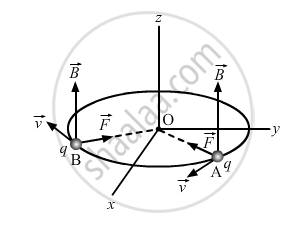
Let m be the mass of the charged particle and r be the radius of the circular path.
`:.q(vecvxxvecB)=(mv^2)/r`
v and B are at right angles:
`:.qvB=(mv^2)/r`
`r=(mv)/(Bq)`
Time period of circular motion of the charged particle can be calculated as shown below:
`T=(2pir)/v`
`=(2pi)/v(mv)/(Bq)`
`T=(2pim)/(Bq)`
∴ Angular frequency is
`omega=(2pi)/T`
|
`:.omega=(Bq)/m` |
Therefore, the frequency of the revolution of the charged particle is independent of the velocity or the energy of the particle.
APPEARS IN
संबंधित प्रश्न
Show that the time period of revolution of particles in a cyclotron is independent of their speeds. Why is this property necessary for the operation of a cyclotron?
Obtain the expression for the cyclotron frequency.
A cyclotron is used to accelerate protons to a kinetic energy of 5 MeV. If the strength of magnetic field in the cyclotron is 2T, find the radius and the frequency needed for the applied alternating voltage of the cyclotron. (Given : Velocity of proton= `3xx10^7 m//s`)
Which of the following particles will describe the smallest circle when projected with the same velocity perpendicular to a magnetic field?
An electron is projected horizontally with a kinetic energy of 10 keV. A magnetic field of strength 1.0 × 10⁻⁷ T exists in the vertically upward direction.
(a) Will the electron deflect towards the right or left of its motion?
(b) Calculate the sideways deflection of the electron while travelling through 1 m. Make appropriate approximations.
Consider a 10-cm long portion of a straight wire carrying a current of 10 A placed in a magnetic field of 0.1 T making an angle of 53° with the wire. What magnetic force does the wire experience?
(a) An electron moves along a circle of radius 1 m in a perpendicular magnetic field of strength 0.50 T. What would be its speed? Is it reasonable? (b) If a proton moves along a circle of the same radius in the same magnetic field, what would be its speed?
Assertion: The frequency of circular motion of a charged particle in cyclotron is independent of the mass of the particle.
Reason: Greater the mass of the particle less will be the frequency of the particle.
