Advertisements
Advertisements
प्रश्न
Advertisements
उत्तर
We have,
\[\frac{dy}{dx} + 2y = x e^{4x} . . . . . \left( 1 \right)\]
Clearly, it is a linear differential equation of the form
\[\frac{dy}{dx} + Py = Q\]
where
\[P = 2\]
\[Q = x e^{4x} \]
\[ \therefore I.F. = e^{\int P\ dx} \]
\[ = e^{ \int2dx } \]
\[ = e^{2x} \]
\[\text{Multiplying both sides of }\left( 1 \right)\text{ by }e^{2x} ,\text{ we get }\]
\[ e^{2x} \left( \frac{dy}{dx} + 2y \right) = e^{2x} \times x e^{4x} \]
\[ \Rightarrow e^{2x} \frac{dy}{dx} + 2 e^{2x} y = x e^{6x} \]
Integrating both sides with respect to x, we get
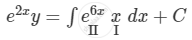
\[ \Rightarrow e^{2x} y = x\int e^{6x} dx - \int\left[ \frac{d}{dx}\left( x \right)\int e^{6x} dx \right]dx + C\]
\[ \Rightarrow e^{2x} y = \frac{x e^{6x}}{6} - \frac{e^{6x}}{36} + C\]
\[ \Rightarrow y = \frac{x e^{4x}}{6} - \frac{e^{4x}}{36} + C e^{- 2x} \]
\[\text{ Hence, }y = \frac{x e^{4x}}{6} - \frac{e^{4x}}{36} + C e^{- 2x}\text{ is the required solution.}\]
APPEARS IN
संबंधित प्रश्न
For the differential equation, find the general solution:
`cos^2 x dy/dx + y = tan x(0 <= x < pi/2)`
For the differential equation, find the general solution:
`x dy/dx + 2y= x^2 log x`
For the differential equation, find the general solution:
`x log x dy/dx + y= 2/x log x`
For the differential equation, find the general solution:
`(x + y) dy/dx = 1`
For the differential equation, find the general solution:
`(x + 3y^2) dy/dx = y(y > 0)`
dx + xdy = e−y sec2 y dy
\[\frac{dy}{dx}\] = y tan x − 2 sin x
Solve the following differential equation: \[\left( \cot^{- 1} y + x \right) dy = \left( 1 + y^2 \right) dx\] .
Find the integerating factor of the differential equation `x(dy)/(dx) - 2y = 2x^2`
Find the integerating factor of the differential equation `xdy/dx - 2y = 2x^2` .
Solve the differential equation: (1 +x2 ) dy + 2xy dx = cot x dx
Solve the following differential equation:
`("x" + 2"y"^3) "dy"/"dx" = "y"`
Solve the following differential equation:
`(1 - "x"^2) "dy"/"dx" + "2xy" = "x"(1 - "x"^2)^(1/2)`
The curve passes through the point (0, 2). The sum of the coordinates of any point on the curve exceeds the slope of the tangent to the curve at any point by 5. Find the equation of the curve.
Form the differential equation of all circles which pass through the origin and whose centers lie on X-axis.
The integrating factor of `(dy)/(dx) + y` = e–x is ______.
Which of the following is a second order differential equation?
The equation x2 + yx2 + x + y = 0 represents
The integrating factor of the differential equation `x (dy)/(dx) - y = 2x^2` is
Let y = y(x), x > 1, be the solution of the differential equation `(x - 1)(dy)/(dx) + 2xy = 1/(x - 1)`, with y(2) = `(1 + e^4)/(2e^4)`. If y(3) = `(e^α + 1)/(βe^α)`, then the value of α + β is equal to ______.
If the solution curve y = y(x) of the differential equation y2dx + (x2 – xy + y2)dy = 0, which passes through the point (1, 1) and intersects the line y = `sqrt(3) x` at the point `(α, sqrt(3) α)`, then value of `log_e (sqrt(3)α)` is equal to ______.
The solution of the differential equation `dx/dt = (xlogx)/t` is ______.
Solve the differential equation `dy/dx+2xy=x` by completing the following activity.
Solution: `dy/dx+2xy=x` ...(1)
This is the linear differential equation of the form `dy/dx +Py =Q,"where"`
`P=square` and Q = x
∴ `I.F. = e^(intPdx)=square`
The solution of (1) is given by
`y.(I.F.)=intQ(I.F.)dx+c=intsquare dx+c`
∴ `ye^(x^2) = square`
This is the general solution.
If sec x + tan x is the integrating factor of `dy/dx + Py` = Q, then value of P is ______.
The slope of tangent at any point on the curve is 3. lf the curve passes through (1, 1), then the equation of curve is ______.
