Advertisements
Advertisements
प्रश्न
Advertisements
उत्तर
We have,
\[\frac{dy}{dx} + 2y = x e^{4x} . . . . . \left( 1 \right)\]
Clearly, it is a linear differential equation of the form
\[\frac{dy}{dx} + Py = Q\]
where
\[P = 2\]
\[Q = x e^{4x} \]
\[ \therefore I.F. = e^{\int P\ dx} \]
\[ = e^{ \int2dx } \]
\[ = e^{2x} \]
\[\text{Multiplying both sides of }\left( 1 \right)\text{ by }e^{2x} ,\text{ we get }\]
\[ e^{2x} \left( \frac{dy}{dx} + 2y \right) = e^{2x} \times x e^{4x} \]
\[ \Rightarrow e^{2x} \frac{dy}{dx} + 2 e^{2x} y = x e^{6x} \]
Integrating both sides with respect to x, we get
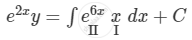
\[ \Rightarrow e^{2x} y = x\int e^{6x} dx - \int\left[ \frac{d}{dx}\left( x \right)\int e^{6x} dx \right]dx + C\]
\[ \Rightarrow e^{2x} y = \frac{x e^{6x}}{6} - \frac{e^{6x}}{36} + C\]
\[ \Rightarrow y = \frac{x e^{4x}}{6} - \frac{e^{4x}}{36} + C e^{- 2x} \]
\[\text{ Hence, }y = \frac{x e^{4x}}{6} - \frac{e^{4x}}{36} + C e^{- 2x}\text{ is the required solution.}\]
APPEARS IN
संबंधित प्रश्न
For the differential equation, find the general solution:
`dy/dx + 2y = sin x`
For the differential equation, find the general solution:
`dy/dx + 3y = e^(-2x)`
For the differential equation, find the general solution:
(1 + x2) dy + 2xy dx = cot x dx (x ≠ 0)
For the differential equation, find the general solution:
`(x + y) dy/dx = 1`
For the differential equation given, find a particular solution satisfying the given condition:
`dy/dx + 2y tan x = sin x; y = 0 " when x " = pi/3`
For the differential equation given, find a particular solution satisfying the given condition:
`dy/dx - 3ycotx = sin 2x; y = 2` when `x = pi/2`
The Integrating Factor of the differential equation `dy/dx - y = 2x^2` is ______.
The integrating factor of the differential equation.
`(1 - y^2) dx/dy + yx = ay(-1 < y < 1)` is ______.
dx + xdy = e−y sec2 y dy
\[\frac{dy}{dx}\] + y cos x = sin x cos x
Find the particular solution of the differential equation \[\frac{dx}{dy} + x \cot y = 2y + y^2 \cot y, y ≠ 0\] given that x = 0 when \[y = \frac{\pi}{2}\].
Solve the following differential equation: \[\left( \cot^{- 1} y + x \right) dy = \left( 1 + y^2 \right) dx\] .
Solve the following differential equation:-
\[\left( 1 + x^2 \right)\frac{dy}{dx} - 2xy = \left( x^2 + 2 \right)\left( x^2 + 1 \right)\]
Solve the differential equation: (1 +x2 ) dy + 2xy dx = cot x dx
If f(x) = x + 1, find `"d"/"dx"("fof") ("x")`
Solve the differential equation: `(1 + x^2) dy/dx + 2xy - 4x^2 = 0,` subject to the initial condition y(0) = 0.
Solve the following differential equation:
`("x" + 2"y"^3) "dy"/"dx" = "y"`
Solve the following differential equation:
`(1 - "x"^2) "dy"/"dx" + "2xy" = "x"(1 - "x"^2)^(1/2)`
Find the equation of the curve which passes through the origin and has the slope x + 3y - 1 at any point (x, y) on it.
The integrating factor of `(dy)/(dx) + y` = e–x is ______.
The integrating factor of the differential equation (1 + x2)dt = (tan-1 x - t)dx is ______.
Integrating factor of `dy/dx + y = x^2 + 5` is ______
The equation x2 + yx2 + x + y = 0 represents
The integrating factor of the differential equation `x (dy)/(dx) - y = 2x^2` is
The integrating factor of differential equation `(1 - y)^2 (dx)/(dy) + yx = ay(-1 < y < 1)`
Let y = y(x), x > 1, be the solution of the differential equation `(x - 1)(dy)/(dx) + 2xy = 1/(x - 1)`, with y(2) = `(1 + e^4)/(2e^4)`. If y(3) = `(e^α + 1)/(βe^α)`, then the value of α + β is equal to ______.
Let y = f(x) be a real-valued differentiable function on R (the set of all real numbers) such that f(1) = 1. If f(x) satisfies xf'(x) = x2 + f(x) – 2, then the area bounded by f(x) with x-axis between ordinates x = 0 and x = 3 is equal to ______.
If the slope of the tangent at (x, y) to a curve passing through `(1, π/4)` is given by `y/x - cos^2(y/x)`, then the equation of the curve is ______.
Solve the differential equation `dy/dx+2xy=x` by completing the following activity.
Solution: `dy/dx+2xy=x` ...(1)
This is the linear differential equation of the form `dy/dx +Py =Q,"where"`
`P=square` and Q = x
∴ `I.F. = e^(intPdx)=square`
The solution of (1) is given by
`y.(I.F.)=intQ(I.F.)dx+c=intsquare dx+c`
∴ `ye^(x^2) = square`
This is the general solution.
The slope of tangent at any point on the curve is 3. lf the curve passes through (1, 1), then the equation of curve is ______.
