Advertisements
Advertisements
प्रश्न
Convert ethane to acetic acid.
Advertisements
उत्तर
Ethane is first converted (oxidised) into ethyl alcohol, and then ethyl alcohol is oxidised into acetic acid in the presence of platinum at 300°C.
\[\ce{\underset{Ethane}{2C2H6} + O2 ->[475K Cu tube][120atm]\underset{Ethyl alcohol}{2C2H5OH}->[Pt][300^\circ C]\underset{Acetic acid}{CH3COOH} + H2O}\]
संबंधित प्रश्न
You have four test tubes, A, B, C and D containing sodium carbonate, sodium chloride, lime water and blue litmus solutions respectively. Out of these the material of which test tube/ test tubes would be suitable for the correct test of acetic/ethanoic acid?
(a) only A
(b) A and B
(c) B and C
(d) A and D
Choose the correct alternative and rewrite the following:
Acetic acid ..................
Draw the structure for the following compound:
Propanoic acid
State any two uses of esters.
Consider the following organic compound:
CH3OH, C2H5OH, CH3COCH3, CH3COOH, C2H5COOH, C4H9COOC2H5, CH4, C2H6, CH3CHO, HCHO
Out of these compound:
Which compound is added to alcohol to denature it?
Which of the following observations is true about dilute solution of acetic acid?
(A) It smells like vinegar and turns red litmus blue
(B) It smells like onion and turns blue litmus red
(C) It smells like orange and turns red litmus blue
(D) It smells like vinegar and turns blue litmus red
Name the first four members of alphatic carboxylic acid.
Give a chemical reaction in which a catalyst is used.
Observe the figure and write the answers to the following questions.
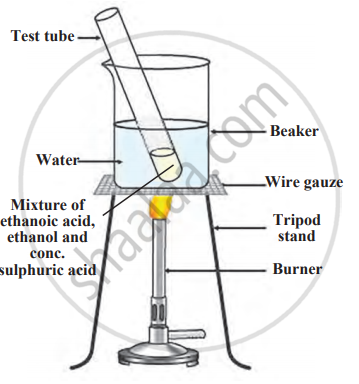
- Write the name of the reaction shown in the following figure.
- Write the above chemical reaction in the form of a balanced equation.
- Write the name of the product produced in the above reaction, write a use.
- Write the name of the catalyst used in the above reaction.
How is ethanol to ethanoic acid an oxidation reaction different from the reaction in which ethanol burns in the presence of oxygen?
