Advertisements
Advertisements
प्रश्न
Construct the following and give justification:
A triangle PQR given that QR = 3 cm, ∠PQR = 45° and QP – PR = 2 cm.
Advertisements
उत्तर
Given, in ΔPQR, QR = 3 cm, ∠PQR = 45° and QP – PR = 2 cm
Since, C lies on the perpendicular bisector RS of AY.
To construct ΔPQR, use the following steps.
1. Draw the base QR of length 3 cm.
2. Make an angle XQR = 45° at point Q of base QR.
3. Cut the line segment QS = QP – PR = 2 cm from the ray QX.
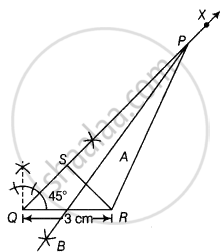
4. Join SR and draw the perpendicular bisector of SR say AB.
5. Let bisector AB intersect QX at P. Join PR. Thus, ΔPQR is the required triangle.
Justification:
Base QR and ∠PQR are drawn as given.
Since, the point P lies on the perpendicular bisector of SR.
PS = PR
Now, QS = PQ – PS
= PQ – PR
Thus, our construction is justified.
APPEARS IN
संबंधित प्रश्न
Construct a triangle ABC in which BC = 7 cm, ∠B = 75° and AB + AC = 13 cm.
Construct a triangle XYZ in which ∠Y = 30°, ∠Z = 90° and XY + YZ + ZX = 11 cm.
Construct a ΔABC in which BC = 3.6 cm, AB + AC = 4.8 cm and ∠B = 60°.
Using ruler and compasses only, construct a ΔABC, given base BC = 7cm, ∠ABC = 60° and AB + AC = 12 cm.
Construct a right-angled triangle whose perimeter is equal to 10 cm and one acute angle equal to 60°.
Construct a triangle ABC such that BC = 6 cm, AB = 6 cm and median AD = 4 cm.
With the help of a ruler and a compass it is not possible to construct an angle of ______.
A triangle ABC can be constructed in which ∠B = 105°, ∠C = 90° and AB + BC + AC = 10 cm.
Construct a triangle whose sides are 3.6 cm, 3.0 cm and 4.8 cm. Bisect the smallest angle and measure each part.
Construct the following and give justification:
A rhombus whose diagonals are 4 cm and 6 cm in lengths.
