Advertisements
Advertisements
प्रश्न
Construct a ΔABC in which BC = 3.6 cm, AB + AC = 4.8 cm and ∠B = 60°.
Advertisements
उत्तर
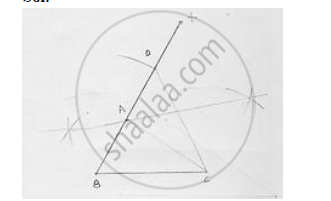
Steps of construction:
1. Draw a line segment BC of 3.6cm.
2. At the point B, draw `∠`xBC of 60°
3. With center B and radius 4.8cm, draw an arc which intersects XB at D.
4. Join DC
5. Draw the perpendicular bisector of DC which intersects DB at A.
6. Join AC
Hence ΔABCis the required triangle
APPEARS IN
संबंधित प्रश्न
Construct a triangle XYZ in which ∠Y = 30°, ∠Z = 90° and XY + YZ + ZX = 11 cm.
Construct a ΔABC in which BC = 3.4 cm, AB − AC = 1.5 cm and ∠B = 45°.
Using ruler and compasses only, construct a ΔABC, given base BC = 7cm, ∠ABC = 60° and AB + AC = 12 cm.
Construct a triangle whose perimeter is 6.4 cm, and angles at the base are 60° and 45° .
Using ruler and compasses only, construct a ΔABC from the following data:
AB + BC + CA = 12 cm, ∠B = 45° and ∠C = 60°.
A triangle ABC can be constructed in which BC = 6 cm, ∠C = 30° and AC – AB = 4 cm.
A triangle ABC can be constructed in which ∠B = 60°, ∠C = 45° and AB + BC + AC = 12 cm.
Construct a triangle ABC in which BC = 5 cm, ∠B = 60° and AC + AB = 7.5 cm.
Construct the following and give justification:
A triangle PQR given that QR = 3 cm, ∠PQR = 45° and QP – PR = 2 cm.
Construct the following and give justification:
A right triangle when one side is 3.5 cm and sum of other sides and the hypotenuse is 5.5 cm.
