Advertisements
Advertisements
प्रश्न
Complete the following sentence.
After the lesson was over, the music teacher asked Lalli if__________________________________.
Advertisements
उत्तर
After the lesson was over, the music teacher asked Lalli if she had seen his chappals.
संबंधित प्रश्न
Match the phrases in Column A with their meanings in Column B.
| A | B | ||
| (i) | broke out | (a) | an attitude of kindness, a readiness to give freely |
| (ii) |
in accordance with |
(b) | was not able to tolerate |
| (iii) | a helping hand | (c) | began suddenly in a violent way |
| (iv) | could not stomach | (d) | assistance |
| (v) | generosity of spirit | (e) | persons with power to make decisions |
| (vi) | figures of authority | (f) | according to a particular rule, principle, or system |
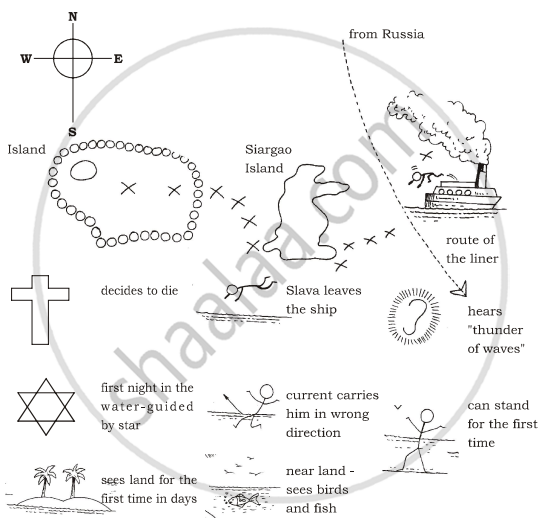
Given below is a map of the area in which Slava Kurilov faced his ordeal. You will also see the major events in the story, in mixed order, each accompanied by a symbol. After you have read ‘Ordeal in the Ocean’, draw the appropriate symbol against each x mark. (One is already drawn for you.) Draw the symbols or number the symbols, and transfer them to the map.)
I wandered lonely as a Cloud
That floats on high o'er vales and Hills,
When all at once I saw a crowd,
A host, of golden Daffodils;
Beside the Lake, beneath the trees,
Fluttering and dancing in the breeze.
Read the lines given above and answer the question that follow.
“If you are rested I would go,” I urged. “Get up and try to walk now.”
“Thank you,” he said and got to his feet, swayed from side to side and then sat down backwards in the dust.
“I was taking care of animals,” he said dully, but no longer to me. “I was only taking care of animals.”
There was nothing to do about him. It was Easter Sunday and the Fascists were advancing toward the Ebro. It was a grey overcast day with a low ceiling so their planes were not up. That and the fact that cats know how to look after themselves was all the good luck that the old man would ever have.
Read the extract given below and answer the question that follow.
When the narrator spoke to the old man about the pigeon cage, what does this reveal about him?
From the day, perhaps a hundred years ago when he sun had hatched him in a sandbank, and he had broken his shell, and got his head out and looked around, ready to snap at anything, before he was even fully hatched-from that day, when he had at once made for the water, ready to fend for himself immediately, he had lived by his brainless craft and ferocity. Escaping the birds of prey and the great carnivorous fishes that eat baby crocodiles, he has prospered, catching all the food he needed, and storing it till putrid in holes in the bank. Tepid water to live in and plenty of rotted food grew him to his great length. Now nothing could pierce the inch-?thick armoured hide. Not even rifle bullets,
which would bounce off. Only the eyes and the soft underarms offered a place. He lived well in the river, sunning himself sometimes with other crocodiles-muggers, as well as the long-? snouted fish-?eating gharials-on warm rocks and sandbanks where the sun dried the clay on them quite white, and where they could plop off into the water in a moment if alarmed. The big crocodile fed mostly on fish, but also on deer and monkeys come to drink, perhaps a duck or two.
Read the extract given below and answer the question that follow.
What protected him now? How?
Suddenly all the tension seemed to ebb out of my body as the truth of what he said hit me. Confidently, I drew a line a full foot in back of the board and proceeded to jump from there. I qualified with almost a foot to spare.
That night I walked over to Luz Long’s room in the Olympic village to thank him. I knew that if it hadn’t been for him I probably wouldn’t be jumping in the finals the following day. We sat in his quarters and talked for two hours—about track and field, ourselves, the world situation, a dozen other things.
When I finally got up to leave, we both knew that a real friendship had been formed. Luz would go out to the field the next day trying to beat me if he could. But I knew that he wanted me to do my best—even if that meant my winning.
Read the extract given below and answer the question that follow.
How did Luz Long help Jesse Owens?
Answer the following question.
Name two things the elephant can do with his trunk, and two he cannot.
When Timothy was about six months old, a change came over him. The phrase in underlined means that
Give some examples of fuel.
How was the bear punished when he attacked a beehive?
Why did the narrator’s Grandfather visit Lucknow?
If you had to make some rules for grown-ups to follow, what would you say? Make at least five such rules. Arrange the lines as in a poem.
How does father react to the mother's warning?
Find pictures of beautiful things you have seen or heard of.
Answer the question.
Why does the poet wonder if teachers also do things that other people do?
How did Jumman treat his old aunt?
The words given against the sentences below can be used both as nouns and verbs. Use them appropriately to fill in the blanks.
(i) The police are _______________________ the area to catch the burglars. (comb)
(ii) An ordinary plastic ______________________________ costs five rupees.
Who was the bearded man?
Why is the window dusty?
What does Banquo’s soliloquy in Act III Scene i of the play Macbeth, reveal about him?
