Advertisements
Advertisements
प्रश्न
Classify the following triangle according to angle:

बेरीज
Advertisements
उत्तर
Since, it has an obtuse angle of 120° Hence, it is obtuse-angled triangle.
shaalaa.com
या प्रश्नात किंवा उत्तरात काही त्रुटी आहे का?
APPEARS IN
संबंधित प्रश्न
Can a triangle have two right angles? Justify your answer in case.
Can a triangle have All angles equal to 60°? Justify your answer in case.
Define a triangle.
If two sides of a triangle are 5 cm and 1.5 cm, the length of its third side cannot be ______.
Find the value of the angle in the given figure:
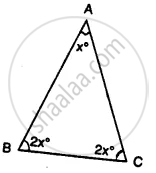
In the following, find the marked unknown angle:
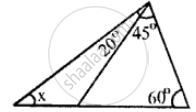
Classify the following triangle according to sides:

The exterior angle of a triangle is equal to the sum of two
In the following figure, ∠BAC = 90° and AD ⊥ BC. The number of right triangles in the figure is ______.

The sides of a triangle must always be connected so that:
