Advertisements
Advertisements
प्रश्न
Choose the correct answer from given options
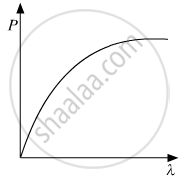
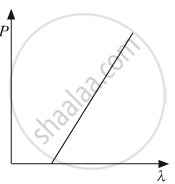
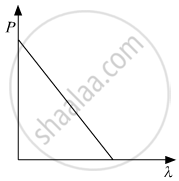
The graph showing the correct variation of linear momentum (p) of a charge particle with its de-Broglie wavelength (λ) is _____________.
पर्याय
Advertisements
उत्तर
The relation between de-Broglie wavelength and the momentum is:
`lambda = h/p`
⇒ `p = h/lambda`
By the above relation, we can conclude that the graph between the momentum and the de-Broglie wavelength is a rectangular hyperbola.
Hence, the correct answer is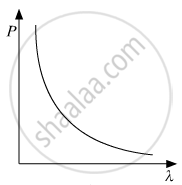
APPEARS IN
संबंधित प्रश्न
Mass of a particle depends on its speed. Does the attraction of the earth on the particle also depend on the particle's speed?
The magnitude of linear momentum of a particle moving at a relativistic speed v is proportional to ______________ .
Find the loss in the mass of 1 mole of an ideal monatomic gas kept in a rigid container as it cools down by 100°C. The gas constant R = 8.3 J K−1 mol−1.
By what fraction does the mass of a boy increase when he starts running at a speed of 12 km h−1?
The energy from the sun reaches just outside the earth's atmosphere at a rate of 1400 W m−2. The distance between the sun and the earth is 1.5 × 10¹¹ m.
(a) Calculate the rate which the sun is losing its mass.
(b) How long will the sun last assuming a constant decay at this rate? The present mass of the sun is 2 × 1030 kg.
An electron and a positron moving at small speeds collide and annihilate each other. Find the energy of the resulting gamma photon.
Through what potential difference should an electron be accelerated to give it a speed of (a) 0.6c, (b) 0.9c and (c) 0.99c?
Find the speed of an electron with kinetic energy (a) 1 eV, (b) 10 keV and (c) 10 MeV.
What is the kinetic energy of an electron in electron volts with mass equal to double its rest mass?
Find the speed at which the kinetic energy of a particle will differ by 1% from its nonrelativistic value \[\frac{1}{2} m_o v^2 .\]
