Advertisements
Advertisements
प्रश्न
Choose the correct alternative:
If the length of diagonal of square is √2, then what is the length of each side?
पर्याय
2
√3
1
4
Advertisements
उत्तर
1
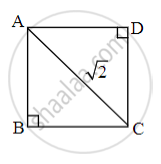
Let ABCD be the given square.
In ∆ABC,
∠B = 90°
∴ AC2 = AB2 + BC2 ...[Pythagoras theorem]
∴ (√2)2 = AB2 + AB2 ...[Sides of the square]
∴ 2 = 2AB2
∴ AB2 = 1
∴ AB = 1 unit
APPEARS IN
संबंधित प्रश्न
In ∆PQR, PQ = √8 , QR = √5 , PR = √3. Is ∆PQR a right-angled triangle? If yes, which angle is of 90°?
Sides of the triangle are 7 cm, 24 cm, and 25 cm. Determine whether the triangle is a right-angled triangle or not.
In the rectangle WXYZ, XY + YZ = 17 cm, and XZ + YW = 26 cm. Calculate the length and breadth of the rectangle?
5 m long ladder is placed leaning towards a vertical wall such that it reaches the wall at a point 4 m high. If the foot of the ladder is moved 1.6 m towards the wall, then find the distance by which the top of the ladder would slide upwards on the wall.
If the sides of a triangle are in the ratio 5 : 12 : 13 then, it is ________
8, 15, 17 is a Pythagorean triplet
The incentre is equidistant from all the vertices of a triangle
Check whether given sides are the sides of right-angled triangles, using Pythagoras theorem
9, 40, 41
Check whether given sides are the sides of right-angled triangles, using Pythagoras theorem
24, 45, 51
The area of a rectangle of length 21 cm and diagonal 29 cm is __________
Choose the correct alternative:
If length of both diagonals of rhombus are 60 and 80, then what is the length of side?
If a triangle having sides 8 cm, 15 cm and 17 cm, then state whether given triangle is right angled triangle or not
A rectangle having dimensions 35 m × 12 m, then what is the length of its diagonal?
In ∆LMN, l = 5, m = 13, n = 12 then complete the activity to show that whether the given triangle is right angled triangle or not.
*(l, m, n are opposite sides of ∠L, ∠M, ∠N respectively)
Activity: In ∆LMN, l = 5, m = 13, n = `square`
∴ l2 = `square`, m2 = 169, n2 = 144.
∴ l2 + n2 = 25 + 144 = `square`
∴ `square` + l2 = m2
∴By Converse of Pythagoras theorem, ∆LMN is right angled triangle.
In ΔABC, AB = 9 cm, BC = 40 cm, AC = 41 cm. State whether ΔABC is a right-angled triangle or not. Write reason.
In the given figure, triangle PQR is right-angled at Q. S is the mid-point of side QR. Prove that QR2 = 4(PS2 – PQ2).

In a right angled triangle, right-angled at B, lengths of sides AB and AC are 5 cm and 13 cm, respectively. What will be the length of side BC?
