Advertisements
Advertisements
प्रश्न
Advertisements
उत्तर
APPEARS IN
संबंधित प्रश्न
What is the SI unit of electric energy?
Name the S.I. unit of electrical energy. How is it related to Wh?
A simple electric circuit has a 30 V battery and a resistor of 60 Ω. What will be the current in the circuit? The resistance of the connecting wires is negligible.
Write the SI units for:
(a) Electric current
(b) Potential difference
(c) Charge.
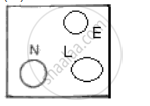
The diagram 31 shows a 3 terminal plug socket.
(i) What is the purpose of the terminal E?
(ii) To which part of the appliance is the terminal E connected?
(iii) To which wire L or N, is the fuse connected and why?
State the position of heating element with respect to principal focus of concave reflector and give reason for choosing this position.
Two lamps are rated 220V, 50W and the other rated 220V, 100W are connected in series with the mains of 220 V. Explain, why the 50W lamp glows more?
How is the amount of heat produced calculated due to the passage of current in a metallic conductor? Derive an expression for it.
With reference to the diagram shown below calculate:

(i) The equivalent resistance between P and Q.
(ii) The reading of ammeter.
(iii) The electrical power between P and Q.
Compare the power used in the 2 Ω resistor in each of the following circuits:
- a 6 V battery in series with 1 Ω and 2 Ω resistors
- a 4 V battery in parallel with 12 Ω and 2 Ω resistors.
