Advertisements
Advertisements
प्रश्न
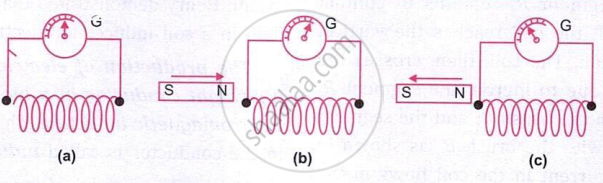
Let us conduct a simple activity to demonstrate electromagnetic induction. Connect a coil of insulated copper to a sensitive ammeter (galvanometer (G)). The galvanometer (G) does not show any deflection, hence no current flows through the coil as shown in Fig. (a).
Now move a bar magnet ((S N)) towards the coil. The galvanometer shows deflection, so long as the motion of the magnet continues as shown in Fig. (b).
Now hold the magnet for some time. There will be no deflection in (G), hence no current flows through the coil. Again, move the magnet away from the coil. (G) again shows deflection as shown in Fig. (c). However, the deflection in (G) or the direction of current in this case is opposite to the previous case.
Advertisements
उत्तर
Introduction: Activity shows that an electric current is produced in a closed coil only when the magnetic flux linked with the coil changes.
Numbered observations and reasons:
- Coil and galvanometer alone: No deflection is shown because there is no change in magnetic flux through the coil; hence no induced current flows.
- Bar magnet moved towards the coil: Deflection appears because relative motion increases the magnetic flux linked with the coil, inducing a current.
- Magnet held still after motion: Deflection disappears because the flux through the coil becomes constant again, so the induced current stops.
- Magnet moved away from the coil: Deflection appears in the opposite direction because the flux linked with the coil decreases, so the induced current reverses.
Direction of induced current:
The direction of the induced current is given by Lenz’s law: the induced current opposes the change in magnetic flux that produced it. Therefore, an approaching magnet and a receding magnet produce induced currents in opposite directions.
Mathematical relation:
The induced electromotive force is related to the rate of change of magnetic flux:
\[\varepsilon = -N\dfrac{d\Phi}{dt}\]
Here (N = 1) for a single coil; the minus sign represents Lenz's law.
Conclusion:
Electromagnetic induction is the production of current due to a changing magnetic flux linked with a coil, as demonstrated by the moving magnet and the galvanometer deflection.
