Advertisements
Advertisements
प्रश्न
By drawing an electron dot diagram, show the lone pair effect leading to the formation of the ammonium ion from ammonia gas and hydrogen ion.
Draw an electron dot diagram that shows the lone pair effect for the formation of - \[\ce{NH^+4}\] ion from NH3 gas and H+.
Advertisements
उत्तर
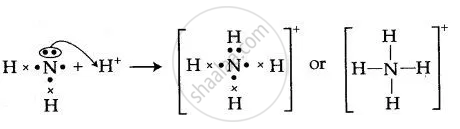
NH3 has one lone pair of electrons which is donated to the hydrogen atom, forming a co-ordinate bond. The arrow represents a co-ordinate bond. The arrow points from donor to acceptor atom.
APPEARS IN
संबंधित प्रश्न
Identify the term/substance in the following:
The electrons present in the outermost shell of an atom.
Choose the most appropriate answer of the following:
Bonding in this molecule can be understood to involve coordinate bonding
(A) Carbon tetrachloride
(B) Hydrogen
(C) Hydrogen chloride
(D) Ammonium chloride
Identify the anion present in the following compounds:
A salt M on treatment with concentrated sulphuric acid produces a gas which fumes in moist air and gives dense fumes with ammonia
Choose the correct answer from the options given below:
A compound X consists of only molecules. Hence, X will have
A. A crystalline hard structure
B. A low melting point and low boiling point
C. An ionic bond
D. A strong force of attraction between its molecules
Why do atoms combine?
Give the conditions for coordinate bond formation.
Choose the correct answer from the options given below
Which one is coordinate molecule?
What is a lone pair of electrons?
Bonding in this molecule can be understood to involve coordinate bonding.
Give reason for the following:
Covalent compounds have a low melting and boiling point.
