Advertisements
Advertisements
प्रश्न
At the foot of a mountain, the elevation of it summit is 45°; after ascending 1000 m towards the mountain up a slope of 30° inclination, the elevation is found to be 60°. Find the height of the mountain.
Advertisements
उत्तर
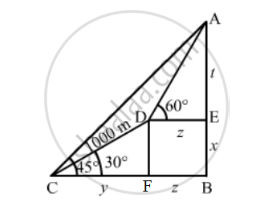
Suppose, AB is a mountain of height t + x.
\[\sin30° = \frac{x}{1000} \]
\[ \Rightarrow x = 1000 \times \left( \frac{1}{2} \right) = 500 m\]
\[\text{ and } \]
\[\tan30° = \frac{x}{y}\]
\[ \Rightarrow y = \frac{x}{\tan30°} = 500\sqrt{3}\]
\[\text{ In } ∆ ABC, \]
\[\tan45°= \frac{t + x}{y + z}\]
\[ \Rightarrow t + x = y + z . . . \left( 1 \right)\]
\[\text{ In } ∆ ADE, \]
\[\tan60° = \frac{t}{z}\]
\[ \Rightarrow t = \sqrt{3}z . . . \left( 2 \right)\]
\[\text{ From } \left( 1 \right) \text{ and } \left( 2 \right), \text{ we have } \]
\[\sqrt{3}z + x = y + z\]
\[ \Rightarrow z\left( \sqrt{3} - 1 \right) = 500\left( \sqrt{3} - 1 \right)\]
\[ \Rightarrow z = 500 m\]
\[ \therefore t = \sqrt{3}z = 500\sqrt{3}\]
Hence, height of the mountain =\[t + x = 500\sqrt{3} + 500 = 500\left( \sqrt{3} + 1 \right) m\]
संबंधित प्रश्न
If in ∆ABC, ∠A = 45°, ∠B = 60° and ∠C = 75°, find the ratio of its sides.
In triangle ABC, prove the following:
In triangle ABC, prove the following:
\[\left( a - b \right) \cos \frac{C}{2} = c \sin \left( \frac{A - B}{2} \right)\]
In triangle ABC, prove the following:
In any triangle ABC, prove the following:
In triangle ABC, prove the following:
In triangle ABC, prove the following:
In triangle ABC, prove the following:
In triangle ABC, prove the following:
In triangle ABC, prove the following:
In triangle ABC, prove the following:
\[a \left( \cos B \cos C + \cos A \right) = b \left( \cos C \cos A + \cos B \right) = c \left( \cos A \cos B + \cos C \right)\]
In ∆ABC, if sin2 A + sin2 B = sin2 C. show that the triangle is right-angled.
In ∆ABC, if a2, b2 and c2 are in A.P., prove that cot A, cot B and cot C are also in A.P.
In \[∆ ABC, if a = 5, b = 6 a\text{ and } C = 60°\] show that its area is \[\frac{15\sqrt{3}}{2} sq\].units.
In \[∆ ABC, if a = \sqrt{2}, b = \sqrt{3} \text{ and } c = \sqrt{5}\] show that its area is \[\frac{1}{2}\sqrt{6} sq .\] units.
In ∆ABC, prove the following: \[c \left( a \cos B - b \cos A \right) = a^2 - b^2\]
In ∆ABC, prove the following:
\[2 \left( bc \cos A + ca \cos B + ab \cos C \right) = a^2 + b^2 + c^2\]
In ∆ABC, prove the following:
\[\left( c^2 - a^2 + b^2 \right) \tan A = \left( a^2 - b^2 + c^2 \right) \tan B = \left( b^2 - c^2 + a^2 \right) \tan C\]
In ∆ABC, prove that \[a \left( \cos B + \cos C - 1 \right) + b \left( \cos C + \cos A - 1 \right) + c\left( \cos A + \cos B - 1 \right) = 0\]
In ∆ABC, prove the following:
\[\sin^3 A \cos \left( B - C \right) + \sin^3 B \cos \left( C - A \right) + \sin^3 C \cos \left( A - B \right) = 3 \sin A \sin B \sin C\]
Answer the following questions in one word or one sentence or as per exact requirement of the question.
In a ∆ABC, if \[\cos A = \frac{\sin B}{2\sin C}\] then show that c = a.
Answer the following questions in one word or one sentence or as per exact requirement of the question.
In a ∆ABC, if b = 20, c = 21 and \[\sin A = \frac{3}{5}\]
Answer the following questions in one word or one sentence or as per exact requirement of the question.
In a ∆ABC, if sinA and sinB are the roots of the equation \[c^2 x^2 - c\left( a + b \right)x + ab = 0\] then find \[\angle C\]
Answer the following questions in one word or one sentence or as per exact requirement of the question.
In ∆ABC, if a = 8, b = 10, c = 12 and C = λA, find the value of λ.
Answer the following questions in one word or one sentence or as per exact requirement of the question.
If the sides of a triangle are proportional to 2, \[\sqrt{6}\] and \[\sqrt{3} - 1\] find the measure of its greatest angle.
Answer the following questions in one word or one sentence or as per exact requirement of the question.
If in a ∆ABC, \[\frac{\cos A}{a} = \frac{\cos B}{b} = \frac{\cos C}{c}\] then find the measures of angles A, B, C.
Answer the following questions in one word or one sentence or as per exact requirement of the question.
In any triangle ABC, find the value of \[a\sin\left( B - C \right) + b\sin\left( C - A \right) + c\sin\left( A - B \right)\
Mark the correct alternative in each of the following:
In a ∆ABC, if a = 2, \[\angle B = 60°\] and\[\angle C = 75°\]
Mark the correct alternative in each of the following:
If the sides of a triangle are in the ratio \[1: \sqrt{3}: 2\] then the measure of its greatest angle is
Mark the correct alternative in each of the following:
In a triangle ABC, a = 4, b = 3, \[\angle A = 60°\] then c is a root of the equation
Mark the correct alternative in each of the following:
In any ∆ABC, \[a\left( b\cos C - c\cos B \right) =\]
If x cos θ = `y cos (theta + (2pi)/3) = z cos (theta + (4pi)/3)`, then find the value of xy + yz + zx.
If x = sec Φ – tan Φ and y = cosec Φ + cot Φ then show that xy + x – y + 1 = 0
[Hint: Find xy + 1 and then show that x – y = –(xy + 1)]
