Advertisements
Advertisements
प्रश्न
Assume the dipole model for earth’s magnetic field B which is given by BV = vertical component of magnetic field = `mu_0/(4pi) (2m cos theta)/r^3` BH = Horizontal component of magnetic field = `mu_0/(4pi) (sin theta m)/r^3` θ = 90° – lattitude as measured from magnetic equator. Find loci of points for which (i) |B| is minimum; (ii) dip angle is zero and (iii) dip angle is ± 45°.
Advertisements
उत्तर
(i) We know from the figure.
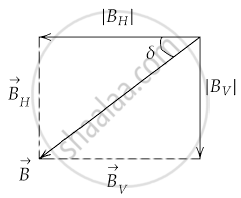
`B^2 + B_V^2 + B_H^2`
= `[mu_0/(4pi) (2m cos theta)/r^3]^2 + [mu_0/(4pi) (m sin theta)/r^3]^2`
Substituting the value of BV and BH from question
= `[mu_0/(4pi)]^2 m^2/r^3 [4cos^2 theta + sin^2 theta]`
`B^2 = (mu_0/(4pi)) xx m^2/r^3 [3 cos^2 theta + 1]`
`B = mu_0/(4pi) m/r^3 [3 cos^2 theta + 1]^(1/2)` ......(i)
From equation (i), the value of B will be minimum when `[3cos^2 theta + 1]^(1/2)` is minimum which will be at `theta= pi/2`. So magnetic equator lies ar `theta = pi/2`, i.e., from magnetic dipole axis `theta = pi/2` for magnetic equator.
(ii) For angle of dip δ
tan δ = `B_r/B_H = (mu_0/(4pi) (2m cos theta)/r^3)/(mu_0/(4pi) (m sin theta)/r^3)`
tan δ = 2 cot θ
For δ = 0, cot θ = 0, θ = `pi/2`
So angle of dip will lie at magnetic equator.
(iii) tan δ = `B_V/B_H` = angle of dip δ = ± 45°
⇒ `B_V/B_H` = tan ± 45°
⇒ `B_V/B_H` = tan 45°
`B_V/B_H` = 1 or BV = BH
δ = ± 45°
tan ± 45° = 2 cos θ .....[∵ tan δ = 2 cot θ]
cot θ = `1/2` or tan θ = 2
θ = tan–12 is the locus of points where the angle of dip δ = ± 45°.
APPEARS IN
संबंधित प्रश्न
Name three elements of the earth's magnetic field which help in defining earth's magnetic field completely.
What is the angle of dip at a place where the horizontal and vertical components of the Earth’s magnetic field are equal?
A horizontal straight wire of length L extending from east to west is falling with speed v at right angles to the horizontal component of Earth’s magnetic field B.
(i) Write the expression for the instantaneous value of the e.m.f. induced in the wire.
(ii) What is the direction of the e.m.f.?
(iii) Which end of the wire is at the higher potential?
A compass needle which is allowed to move in a horizontal plane is taken to a geomagnetic pole. It ______.
What happens to the angle of dip as we move towards magnetic pole from magnetic equator?
Solve the following problem.
A magnet makes an angle of 45° with the horizontal in a plane making an angle of 30° with the magnetic meridian. Find the true value of the dip angle at the place.
Answer the following question regarding earth’s magnetism:
A vector needs three quantities for its specification. Name the three independent quantities conventionally used to specify the earth’s magnetic field.
The earth’s magnetic field varies from point to point in space. Does it also change with time? If so, on what time scale does it change appreciably?
The earth may have even reversed the direction of its field several times during its history of 4 to 5 billion years. How can geologists know about the earth’s field in such distant past?
Interstellar space has an extremely weak magnetic field of the order of 10–12 T. Can such a weak field be of any significant consequence? Explain.
A short bar magnet placed in a horizontal plane has its axis aligned along the magnetic north-south direction. Null points are found on the axis of the magnet at 14 cm from the centre of the magnet. The earth’s magnetic field at the place is 0.36 G and the angle of dip is zero. What is the total magnetic field on the normal bisector of the magnet at the same distance as the null point (i.e., 14 cm) from the centre of the magnet? (At null points, field due to a magnet is equal and opposite to the horizontal component of earth’s magnetic field.)
If the inclination is θ, the horizontal component of the earth’s field is HE and the vertical component of the earth’s field is ZE, then tan(θ) is ______.
At a given place on earth’s surface the horizontal component of earth’s magnetic field is 2 × 10³-5 T and resultant magnetic field is 4 × 10³-5 T. The angle of dip at this place is ______.
Assertion(A): A magnetic needle free to rotate in a vertical plane, orients itself (with its axis) vertical at the poles of the earth.
Reason (R): At the poles of the earth the horizontal component of earth’s magnetic field will be zero.
Select the most appropriate answer from the options given below:
A 10-meter wire is kept in east-west direction. It is falling down with a speed of 5.0 meter/second, perpendicular to the horizontal component of earth's magnetic field of 0.30 × 10⁻⁴ weber/meter2. The momentary potential difference induced between the ends of the wire will be:
The angle between the magnetic meridian and geographical meridian is called ______
Isogonic lines are those for which ______.
