Advertisements
Advertisements
प्रश्न
Arrange the following.
Increasing order of basic strength C6H5NH2, C6H5N(CH3)2, (C2H5)2NH and CH3NH2.
Advertisements
उत्तर
Due to the delocalization of the lone pair of electrons of the N-atom over the benzene ring, all aromatic amines are less basic than alkylamines i.e., CH3NH2. The presence of electron-donating groups (– CH3) on the N-atom increases the basicity of substituted aniline with respect to C6H5NH2.
In (C6H5)NH2, the lone pair of electrons on the N-atom is delocalized over two benzene rings instead of one in C6H5NH2, therefore (C6H5)NH2 is much less basic than C6H5NH2. Combining all the three trends together, the basic strength of the four amines increasing in order.
(C6H5)NH2 < (C2H5)2NH < C6H5N(CH3)2 < CH3NH2
APPEARS IN
संबंधित प्रश्न
Choose the most correct option.
The hybridisation of nitrogen in primary amine is ____________.
\[\ce{Aniline + benzoylchloride ->[NaOH] C6H5 - NH - COC6H5}\] this reaction is known as ____________.
The product formed by the reaction an aldehyde with a primary amine ____________.
Account for the following.
Gabriel phthalimide synthesis is preferred for synthesising primary amines.
Identify A, B and C.
\[\ce{CH3 - NO2 ->[LiAlH4] A ->[2CH3CH2Br] B ->[H2SO4] C}\]
The following amine can be classified as:

Classify the following amine as primary, secondary or tertiary:
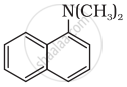
Write short note on the following.
Ammonolysis
Account for the following:
Aniline does not undergo Friedel-Crafts reaction.
Write short note on the following:
Ammonolysis
