Advertisements
Advertisements
प्रश्न
Answer the following question.
Why did the king want no more talk about the hilsa-fish?
Advertisements
उत्तर
The king did not want any more talk about the hilsa-fish because it was the season for hilsa-fish and no one could stop talking about it for even five minutes. He was getting annoyed with all the talk about hilsa-fish.
संबंधित प्रश्न
The passing of time will no longer affect her, says the poet. Which lines of the poem say this?
When we meet people, we notice their faces more than anything else. The box below contains words which describe the features of a face. Work in pairs and list them under the appropriate headings, then add more words of your own.
| twinkling | shifty | discoloured | short | oval |
| pear-shaped | large | close-cropped | broken | long |
| protruding | gapped | thick | pointed | wide |
| fair | thin | pale | swarthy | staring |
| square | round | untidy | close-set | neat |
| wavy | upturned |
| Shape of face | Complexion | Eyes | Hair | Nose | Lips | Teeth |
The Mystery of Bermuda Triangle.
In groups of six, work on one of the mysteries given below by surfing the net and through other sources. Create a power point presentation/a photo essay.
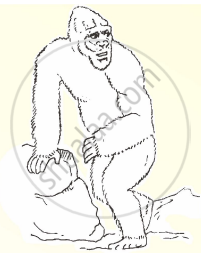
- Yeti, the abominable snowman
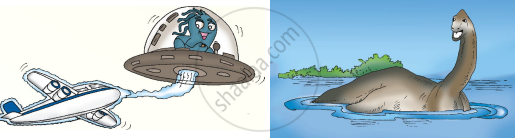
- Loch Ness Monster
- UFOs (Unidentified Flying Objects)
- Lost city of Atlantis
- Crop circles
- Nazca lines
Read the following passage on New Zealand.
New Zealand is a Mecca for nature lovers. Throughout most of New Zealand's geological history, it was a bird's paradise. The islands were once part of the southern super - continent Gondwana from which they broke off around 80 million years ago before mammals had evolved and spread.
(courtesy: Terra Green Sept 2008 issue 06)
The underlined words express a relationship usually of space or time between the words with which they stand. Such 'Positional' words which are used before nouns (pre-position) are called prepositions.

What does he plant who plants a tree? a
He plants a friend of sun and sky;b
He plants the flag of breezes free;
The shaft of beauty, towering high;
He plants a home to heaven anigh;
For song and mother-croon of bird
In hushed and happy twilight heard____
The treble of heaven's harmony_____
These things he plants who plants a tree.
Read the lines given above and answer the question that follow:
"My father lived at Blenheim then,
Yon little stream hard by;
They burnt his dwelling to the ground,
And he was forced to fly;
So with his wife and child he fled,
Nor had he where to rest his head.
"With fire and sword the country round
Was wasted far and wide,
And many a childing mother then,
And new-born baby died;
But things like that, you know, must be
At every famous victory;
Read the lines given above and answer the question that follow.
What does Kasper’s attitude signify?
Oh yes, we know it keeps them still,
They don't climb out the window sill,
They never fight or kick or punch,
They leave you free to cook the lunch
And wash the dishes in the sink....
But did you ever stop to think,
To wonder just exactly what
This does to your beloved tot?
IT ROTS THE SENSE IN THE HEAD!
IT KILLS IMAGINATION DEAD!
IT CLOGS AND CLUTTERS UP THE MIND!
IT MAKES A CHILD SO DULL AND BLIND
HE CAN NO LONGER UNDERSTAND
A FANTASY, A FAIRYLAND!
HIS BRAIN BECOMES AS SOFT AS CHEESE!
HIS POWERS OF THINKING RUST AND FREEZE!
HE CANNOT THINK - HE ONLY SEES!
Read the lines given above and answer the question given below.
Explain with reference to context.
The waves beside them danced, but they
Out-did the sparkling leaves in glee;
A poet could not be but gay,
In such a jocund company!
I gazed-and gazed-but little thought
What wealth the show to me had brought:
Read the lines given above and answer the question that follow.
Which wealth is referred to by the poet?
To us the ashes of our ancestors are sacred and their resting place is hallowed ground. You wander far from the graves of your ancestors and seemingly without regret. Your religion was written upon tablets of stone by the iron finger of your God so that you could not forget. The Red Man could never comprehend or remember it. Our religion is the traditions of our ancestors — the dreams of our old men, given them in solemn hours of the night by the Great Spirit; and the visions of our sachems, and is written in the hearts of our people.
Day and night cannot dwell together. The Red Man has ever fled the approach of the White Man, as the morning mist flees before the morning sun. However, your proposition seems fair and I think that my people will accept it and will retire to the reservation you offer them. Then we will dwell apart in peace, for the words of the Great White Chief seem to be the words of nature speaking to my people out of dense darkness.
Read the extract given below and answer the question that follow.
Why do the dead of the Tribals never forget them or this beautiful world?
Margot stood alone. She was a very frail girl who looked as if she had been lost in the rain for years and the rain had washed out the blue from her eyes and the red from her mouth and the yellow from her hair. She was an old photograph dusted from an album, whitened away, and if she spoke at all her voice would be a ghost. Now she stood, separate, staring at the rain and the loud wet world beyond the huge glass. “What’re you looking at ?” said William. Margot said nothing. “Speak when you’re spoken to.” He gave her a shove. But she did not move; rather she let herself be moved only by him and nothing else. They edged away from her, they would not look at her. She felt them go away. And this was because she would play no games with them in the echoing tunnels of the underground city. If they tagged her and ran, she stood blinking after them and did not follow. When the class sang songs about happiness and life and games her lips barely moved. Only when they sang about the sun and the summer did her lips move as she watched the drenched windows.
Read the extract given below and answer the question that follow.
What did Margot look like?
Read the extract given below and answer the questions that follow :
Duke: You hear the team’d Bellario, what he writes:
And here, I take it, is the doctor come.
[Enter Portia, dressed like a Doctor of Laws]
Give me your hand. Come you from old Bellario”?
Portia: I did, my lord.
Duke: You are welcome : take your place.
Are you acquainted with the difference
That holds this present question in the court?
(i) Where is this scene set? Why was Portia there?
(ii) What reason had Bellario given for his absence? Whom had he sent in this stead?
(iii) Bellario's letter stated that he had taken some measures to prepare the 'young and learned doctor' to deal with the case. What were they?
(iv) What was the 'difference' between Shylock the Jew and Antonio the merchant that the Duke was unable to resolve?
(v) How does Portia succeed in saving Antonio? What does this reveal of her character?
The following sentence has two blanks. Fill in the blanks with appropriate forms of the word given in brackets.
It isn’t__________ that_________ should always be the mother of invention. (necessary)
Mark the right item.
The old farmer and his wife loved the dog
Where did Mr Wonka carry on his experiments?
What did the Keepers of the zoo reveal to the narrator’s grandfather?
Why did the crocodile’s wife want to eat the monkey’s heart?
In what respect was the wrestling match strange? Who were the two rivals? Who was the winner?
Give two example of trees that have a number of uses in everybody’s life.
Complete the following sentence.
The old banyan tree “did not belong” to grandfather, but only to the boy, because _________
