Advertisements
Advertisements
प्रश्न
Answer the following question.
“He stood on his head in delight.”
(i) Who does ‘he’ refer to?
(ii) Why was he delighted?
Advertisements
उत्तर
(i) ‘He’ refers to the bear, Bruno.
(ii) Bruno was delighted to see the narrator’s wife after three months of separation.
संबंधित प्रश्न
Answer of these question in a short paragraph (about 30 words).
Why was Margie doing badly in geography? What did the County Inspector do to help
her?
Look at the passage below and study how the personal pronouns refer to different people.
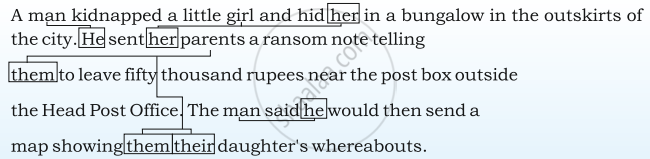
Teacher/Students will read out an interview between a radio jockey and a pilot. (Page 174)
"My father lived at Blenheim then,
Yon little stream hard by;
They burnt his dwelling to the ground,
And he was forced to fly;
So with his wife and child he fled,
Nor had he where to rest his head.
"With fire and sword the country round
Was wasted far and wide,
And many a childing mother then,
And new-born baby died;
But things like that, you know, must be
At every famous victory;
Read the lines given above and answer the question that follow.
Explain with reference to context.
The angel wrote and vanished.
The next night, It came again with a great wakening light,
And show's the names whom love of God had blest,
And Lo! Bin Adhem's name led all the rest.
Read the lines given above and answer the following question.
Mention two other words used by the poet to refer to the angel.
Easton, with a little laugh, as if amused, was about to speak again when the other forestalled him. The glum-faced man had been watching the girl’s countenance with veiled glances from his keen, shrewd eyes.
“You’ll excuse me for speaking, miss, but, I see you’re acquainted with the marshall here. If you’ll ask him to speak a word for me when we get to the pen he’ll do it, and it’ll make things easier for me there. He’s taking me to Leavenworth prison. It’s seven years for counterfeiting.”
“Oh!” said the girl, with a deep breath and returning color. “So that is what you are doing out here? A marshal!”
“My dear Miss Fairchild,” said Easton, calmly, “I had to do something. Money has a way of taking wings unto itself, and you know it takes money to keep step with our crowd in Washington. I saw this opening in the West, and—well, a marshalship isn’t quite as high a position as that of ambassador, but—”
Read the extract given below and answer the question that follow.
What was the crime of the prisoner? And what is the punishment.
After considering the matter, and talking it over with his wife, farmer Jones said that he would take John, and do well by him, now that his mother was out of the way; and Mrs. Ellis, who had been looking out for a bound girl, concluded that it would be charitable in her to make choice of Katy, even though she was too young to be of much use for several years.
“I could do much better, I know,” said Mrs. Ellis; “but as no one seems inclined to take her, I must act from a sense of duty expect to have trouble with the child; for she’s an undisciplined thing—used to having her own way.”
But no one said “I’ll take Maggie.” Pitying glances were cast on her wan and wasted form and thoughts were troubled on her account. Mothers brought cast-off garments and, removing her soiled and ragged clothes, dressed her in clean attire. The sad eyes and patient face of the little one touched many hearts, and even knocked at them for entrance. But none opened to take her in. Who wanted a bed-ridden child?
“Take her to the poorhouse,” said a rough man, of whom the question “What’s to be done with Maggie?” was asked. “Nobody’s going to be bothered with her.”
“The poorhouse is a sad place for a sick and helpless child,” answered one.
“For your child or mine,” said the other, lightly speaking; “but for tis brat it will prove a blessed change, she will be kept clean, have healthy food, and be doctored, which is more than can be said of her past condition.”
Read the extract given below and answer the question that follow.
What solution did the rough man suggest for Maggie? Why would the poorhouse be a good place for Maggie?
Find in the poem lines that match the following. Read both one after the other.
The rebel refuses to cut his hair.
Why has sleep been called a wonder?
Write two pairs of rhyming words from the poem.
Give the list of the animals the Dog agreed to accompany and serve. Why did it reject them all?
What did the speaker do while hiding himself in the banyan tree branches?
What is the mystery about the child’s school teacher? How does it plan to discover the truth?
Where are rattlesnakes found?
With your partner, complete the following sentence in your own word using the ideas in the poem.
One has to match __________________.
Complete the following sentences from memory choosing a phrase from those given in brackets.
Tradesmen came to the village with all kinds of goods ____________
Give a synonym for ‘like’ in the context of the poem.
Read the following conversation.
Ravi: What are you doing?
Mridu: I’m reading a book.
Ravi: Who wrote it?
Mridu: Ruskin Bond.
Ravi: Where did you find it?
Mridu: In the library.
Notice that ‘what’, ‘who’, ‘where’, are question words. Questions that require information begin with question words. Some other question words are ‘when’, ‘why’, ‘where’, ‘which’ and ‘how’.
Remember that
- What asks about acting, things etc.
- Who asks about people.
- Which asks about people or things.
- Where asks about place.
- When asks about time.
- Why asks about reason or purpose.
- How asks about means, manner or degree.
- Whose asks about possessions.
Read the following paragraph and frame questions on the italicised phrases.
Anil is in school. I am in school too. Anil is sitting in the left row. He is reading a book. Anil’s friend is sitting in the second row. He is sharpening his pencil. The teacher is writing on the blackboard. Children are writing in their copybooks. Some children are looking out of the window.
The words helper, companion, partner and accomplice have very similar meanings, but each word is typically used in certain phrases. Can you fill in the blanks below with the most commonly used words? A dictionary may help you.
business ……………
In the short story, B. Wordsworth, when the narrator’s mother refuses to buy B. Wordsworth's poem, B. Wordsworth remarks 'It is the poet's tragedy' because ______.
