Advertisements
Advertisements
प्रश्न
An increase in perimeter of a figure always increases the area of the figure.
पर्याय
True
False
Advertisements
उत्तर
This statement is False.
Explanation:
 |
 |
| (i) | (ii) |
This is not necessary.
Perimeter of a closed figure is the distance around it while area is the measure of the part of plane or region enclosed by it.
Hence, perimeter of (ii) is greater than that of (i), but its area is smaller than that of (i).
APPEARS IN
संबंधित प्रश्न
The length and the breadth of a conference hall are in the ratio 7: 4 and its perimeter is 110 m. Find:
(i) area of the floor of the hall.
(ii) a number of tiles, each a rectangle of size 25 cm x 20 cm, required for the flooring of the hall.
(iii) the cost of the tiles at the rate of ₹ 1,400 per hundred tiles.
A school playground is rectangular in shape with length = 120 m and breadth = 90 m. Some school boys run along the boundary of the play-ground and make 15 complete rounds in 45 minutes. How much distance they run during this period.
Find the perimeter of an isosceles triangle with each equal side = 13 cm and the third side = 10 cm.
A rectangle with length = 18 cm and breadth = 12 cm has same perimeter as that of a regular pentagon. Find the side of the pentagon.
A regular pentagon of each side 12 cm has same perimeter as that of a regular hexagon. Find the length of each side of the hexagon.
Each side of a square tile is 60 cm. How many tiles will be required to cover the floor of a hall with length = 50 m and breadth = 36 m.
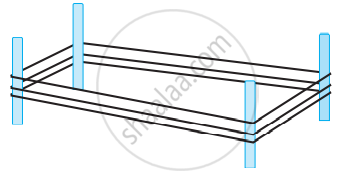
A farmer has a rectangular field of length and breadth 240 m and 180 m respectively. He wants to fence it with 3 rounds of rope as shown in the figure. What is the total length of rope he must use?
Each side of a square is 9 m long. Find its perimeter.
The table given below contains some measures of the rectangle. Find the unknown values.
| Length | Breadth | Perimeter | Area |
| 5 cm | 8 cm | ? | ? |
In the following figure, perimeter of (ii) is greater than that of (i), but its area is smaller than that of (i).
|
|
| (i) | (ii) |
