Advertisements
Advertisements
प्रश्न
(a) An emf e = e0 sin ωt applied to a series L - C - R circuit derives a current I = I0sinωt in the circuit. Deduce the expression for the average power dissipated in the circuit.
(b) For circuits used for transporting electric power, a low power factor implies large power loss in transmission. Explain.
Advertisements
उत्तर
Instantaneous power,
P = ei = (e0 sin ωt) [i0 sin (ωt ± Φ)]
= e0i0 sin ωt (sin ωt cos Φ ± cos ωt sin Φ)
= e0i0 cos Φ sin2 ωt ± e0i0 sin Φ sin ωt cos ωt
Average power over one cycle,
`"P"_"av" = "work done in one cycle"/"time for one cycle"`
`= (int_0^"T" "P dt")/"T"`
`= (int_0^"T" ["e"_0"i"_0 cos phi sin^2 omega"t" +- "e"_0"i"_0 sin phi sin omega "t"]"dt")/"T"`
`= ("e"_0"i"_0)/"T" [cos phi int_0^"T" sin^2 omega "t dt" +- sin phi int_0^"T" sin omega "t" cos omega "t" "dt"]`
Now, `int_0^"T" sin^2 omega "t dt" = int_0^"T" ((1 - cos 2 omega "t")/2)`dt
`= int_0^"T" 1/2 "dt" - int_0^"T" (cos 2 omega "t")/2 "dt" = "T"/2 - 1/2 ((sin 2 omega "t")/(2omega))_0^"T"`
`= "T"/2 - 1/(4omega)(sin 2omega"T" - sin 0)`
`= "T"/2 - 1/(4omega) [sin 2((2pi)/"T")"T" - 0]`
`= "T"/2 - 1/(4omega) [0 - 0] = "T"/2`
Also,
`int_0^"T" sin omega"t" cos omega"t" "dt" = 1/2 int_0^"T" sin 2 omega"t" "dt" = 1/2 [(- cos 2 omega"t")/(2omega)]_0^"T"`
`= - 1/(4omega) [cos 2((2pi)/"T")"T" - cos 0] = - 1/(4omega)[1 - 1] = 0`
Hence, `"P"_"av" = ("e"_0"i"_0)/"T" cos phi xx "T"/2 = ("e"_0"i"_0)/2 cos phi`
`= "e"_0/sqrt2 * "i"_0/sqrt2 cos phi`
`= "e"_"rms""i"_"rms" cos phi = "e"_"rms""i"_"rms" ("R"/"Z")`, where the impedance Z = `sqrt("R"^2 +("X"_"L" - "X"_"C")^2)`
(b) `"P"_"av" = "e"_"rms""i"_"rms" cos phi`
The cos Φ factor is also known as the power factor. A low power factor in a circuit used to transport electric power means that the power available on transportation is much less than `"e"_"rms""i"_"rms"`. It denotes a significant loss of power during transport.
APPEARS IN
संबंधित प्रश्न
Obtain an expression for average power dissipated in a purely resistive A.C. circult.
A resistor of 500 Ω and an inductance of 0.5 H are in series with an AC source which is given by V = `100 sqrt2` sin (1000 t). The power factor of the combination is ______.
In a series LCR circuit, the phase difference between the voltage and the current is 45°. Then the power factor will be ______.
When an AC source is connected to an ideal inductor show that the average power supplied by the source over a complete cycle is zero.
Prove that an ideal capacitor in an AC circuit does not dissipate power
An AC circuit consists of only an inductor of inductance 2 H. If the current is represented by a sine wave of amplitude 0.25 A and frequency 60 Hz, calculate the effective potential difference across the inductor. (π = 3.142)
A 25 μF capacitor, a 0.10 H inductor, and a 25Ω resistor are connected in series with an AC source whose emf is given by e = 310 sin 314 t (volt). What is the frequency, reactance, impedance, current, and phase angle of the circuit?
A 100 μF capacitor is charged with a 50 V source supply. Then source supply is removed and the capacitor is connected across an inductance, as a result of which 5A current flows through the inductance. Calculate the value of the inductance.
Give any one definition of power factor.
In series 'LR' circuit and in series 'RC' circuit, same current is flowing. If the frequency of e.m.f. of a.c. is increased for both the circuits, the impedance will ____________.
In LCR series circuit, an alternating e.m.f. 'e' and current 'i' are given by the equations e = 100 sin (100 t) volt,
`"i" = 100 "sin" (100"t" + pi/3)"mA"`.
The average power dissipated in the circuit will be ____________.
The voltage gain of a CE amplifier is 50. A sinusoidal ac of amplitude 10 mV is applied as a signal. The output of the amplifier will be ______.
In a series LR circuit XL = R and power factor of the circuit is P1. When capacitor with capacitance C such that XL= XC is put in series, the power factor becomes P2. The ratio `"P"_1/"P"_2` is ______.
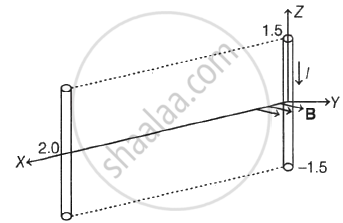
A conductor lies along the Z-axis at −1.5 ≤ Z ≤ 1.5 m and carries a fixed current of 10.0 A in −az direction as (see figure). For a field B = 3.0 × 10⁻⁴`"e"^(−0.2"x")`ay T, find the power required to move the conductor at constant speed to x = 2.0 m, y = 0 in 5 × 10⁻³ s. Assume parallel motion along the x-axis.
The power factor of LCR circuit is ______.
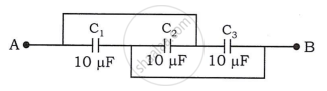
The effective capacitor between A and B in the following circuit is ______.
Explain the theory of an AC circuit with a resistor.
Where is the power dissipated in an alternating current circuit?
In an a.c. circuit, voltage and current are given by:
V = 100 sin (100 t) V and I = `100 sin (100 t + pi/3)` mA respectively.
The average power dissipated in one cycle is:
What is the power in a DC circuit?
Why is power delivered to an AC circuit not simply the product of voltage and current magnitudes?
What is the phase angle in a pure resistive circuit?
What is another name for wattless current?
What is the average power when \[\cos\phi=0\]?
In the instantaneous-power expression, what does \[V_m\] represent?
In the instantaneous-power expression, what does \[I_m\] represent?
What does \[\omega\] represent in the instantaneous-power expression?
What does \[\phi\] represent in the voltage and current expressions for a series LCR circuit?
In a circuit where current lags voltage, which ratio gives the power factor?
Which component of current is along the applied voltage \[V\]?
Why is \[I_q\] called the wattless component?
What is the impedance of a series LCR circuit with \[R=3\,\Omega\], \[X_L=8\,\Omega\], and \[X_C=4\,\Omega\]?
What phase difference is obtained from \[\phi=\tan^{-1}((X_C-X_L)/R)\] when \[X_C=4\,\Omega\], \[X_L=8\,\Omega\], and \[R=3\,\Omega\]?
What is the resonance frequency corresponding to \[\omega_0=222.1\,\mathrm{rad/s}\]?
What is the impedance of a series LCR circuit at resonance when \[R=3\,\Omega\]?
On what principle does a metal detector doorway work?
What circuit arrangement does a person walk through in a metal detector doorway?
