Advertisements
Advertisements
प्रश्न
An element P disintegrates by α - -emission and the new element suffers two further disintegrations, both by β -emission, to form an element Q. Explain the fact that P and Q are the isotopes.
Advertisements
उत्तर
The atomic number of P decreases by 2 and mass no. decreases by 4 due to the emission of one alpha particle and then increases by 1 due to the emission of each beta particle, so the atomic number of Q formed after the emission of one alpha and two beta particles is same as that of P. Hence P and Q are the isotopes.
संबंधित प्रश्न
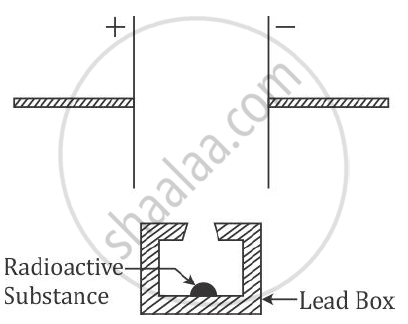
Complete the diagram as given above by drawing the deflection of radioactive radiations in an electric field
State two dissimilarities between the γ-rays and X-rays.
A nucleus of an element X which has the symbol `""_84^202` X emits an alpha particle and then a beta particle. The final nucleus is `""_"b"^"a"` Y Find a and b.
Name the three main parts of a Cathode Ray Tube.
Which part of the atom undergoes a change in the process of radioactive decay?
State three ways of obtaining an electron-beam.
Two radioactive sources A and B of half lives of 1 hour and 2 hours, respectively, initially contain the same number of radioactive atoms. At the end of two hours, their rates of disintegration are in the ratio of ______.
Complete the following radioactive reaction:
\[\ce{^-_-X -> ^-_-Y + ^4_2He -> ^234_91Z + ^0_-1e}\]
Which of the following correctly lists the three major types of radioactive decay found in nature?
