Advertisements
Advertisements
प्रश्न
An alkene ‘A’ on ozonolysis gives a mixture of ethanal and pentan-3-one. Write structure and IUPAC name of ‘A’.
Advertisements
उत्तर
\[\begin{array}{cc}
\phantom{....................................................}\ce{^5CH3}\\
\phantom{..................................................}|\\
\phantom{...................................................}\ce{^4CH2}\\
\phantom{..................................................}|\\
\ce{A + O3 ->[Zn + H2O] H3C - C = O + ^1CH3 - ^2CH2 - ^3C}\\
\phantom{.......................}|\phantom{...........................}||\\
\phantom{.........................}\ce{\underset{Ethanal}{H}}\phantom{....................}\ce{\underset{Pentan - 3 - one}{O}}
\end{array}\]
During ozonolysis, an ozonide having a cyclic structure is formed as an intermediate which undergoes cleavage to give the final products. Ethanal and pentan-3-one are obtained from the intermediate ozonide. Hence, the expected structure of the ozonide is:

This ozonide is formed as an addition of ozone to ‘A’. The desired structure of ‘A’ can be obtained by the removal of ozone from the ozonide. Hence, the structural formula of ‘A’ is:
\[\begin{array}{cc}
\ce{H3^1C - ^2CH = ^3C - ^4CH2 - ^5CH3}\\
\phantom{.}|\\\phantom{..........}\ce{CH2 - CH3}\end{array}\]
The IUPAC name of ‘A’ is 3-Ethylpent-2-ene.
APPEARS IN
संबंधित प्रश्न
An alkene ‘A’ contains three C – C, eight C – H σ bonds and one C – C π bond. ‘A’ on ozonolysis gives two moles of an aldehyde of molar mass 44 u. Write IUPAC name of ‘A’.
Propanal and pentan-3-one are the ozonolysis products of an alkene? What is the structural formula of the alkene?
Write a chemical equation for combustion reaction of the following hydrocarbon:
Butane
Write a chemical equation for combustion reaction of the following hydrocarbon:
Pentene
Write a chemical equation for combustion reaction of the following hydrocarbon:
Hexyne
Write a chemical equation for combustion reaction of the following hydrocarbon:
Toluene
Arrange the halogens F2, Cl2, Br2, I2, in order of their increasing reactivity with alkanes.
Which of the following alkenes on ozonolysis give a mixture of ketones only?
| (i) | CH3 – CH = CH – CH3 |
| (ii) | \[\begin{array}{cc} \ce{CH3 - C - CH = CH2}\\ |\phantom{.......}\\ \ce{CH3}\phantom{....} \end{array}\] |
| (iii) | 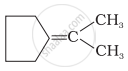 |
| (iv) | \[\begin{array}{cc} \phantom{...................}\ce{CH3}\\ \phantom{..............}/\\ \ce{(CH3)2 C = C}\\ \phantom{..............}\backslash\\ \phantom{...................}\ce{CH3} \end{array}\] |
An alkene 'X' on ozonolysis produces two moles of isovaleraldehyde. Predict the IUPAC name of the alkene.
Which of the following reagent is used for the following reaction?
\[\ce{CH3CH2CH3 ->[?] CH3CH2CHO}\]
The major product formed in the following reactions is:


Select schemes A, B, C out of
(I) acid catalysed hydration
(II) HBO
(III) oxymercuration-demercuration
What would be the main product when propene reacts with HBr?
3-Methyl-pent-2-ene on reaction with HBr in presence of peroxide forms an addition product. The number of possible stereoisomers for the product is ______.
In the presence of peroxide, HCl and HI do not give anti-Markovnikov's addition of alkenes because ______.
An alkene ‘A’ contains three C – C, eight C – H σ bonds and one C – C π bond. ‘A’ on ozonolysis gives two moles of an aldehyde of molar mass 44 u. Write the IUPAC name of ‘A’.
Which of the following is the key step in the manufacture of sulphuric acid?
