Advertisements
Advertisements
प्रश्न
Δ AMT ∼ ΔAHE. In Δ AMT, MA = 6.3 cm, ∠MAT = 120°, AT = 4.9 cm, `(MA)/(HA) = 7/5`. construct Δ AHE.
Advertisements
उत्तर
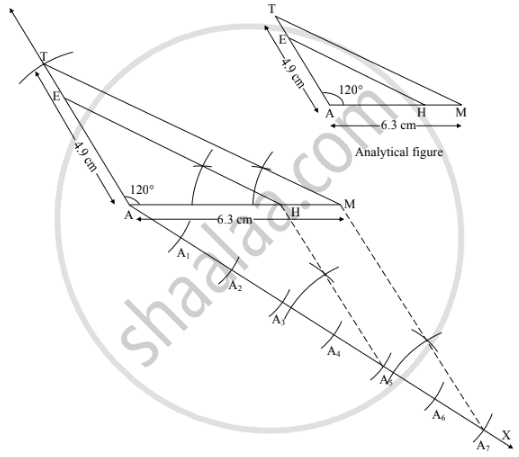
Drawing Δ AMT of given measure
Drawing a ray making an acute angle at A with side AM. mark points `A_1 , A_2 , ...., A_7 " such that " A A_1 = A_1A_2 = A_2 A_3 = A_3 A_4 = A_4 A_5 = A_5 A_6 = A_6 A_7` Joining A7 and M and drawing seg A5 H parallel to A7M, where H is the point on AM
Drawing HE || side MT
Δ AHE is the required triangle similar to ΔAMT.
APPEARS IN
संबंधित प्रश्न
Construct the circumcircle and incircle of an equilateral triangle ABC with side 6 cm and centre O. Find the ratio of radii of circumcircle and incircle.
Construct a triangle ABC in which AB = 5 cm, BC = 6 cm and ∠ABC = 60˚. Now construct another triangle whose sides are 5/7 times the corresponding sides of ΔABC.
Construct a triangle ABC in which BC = 6 cm, AB = 5 cm and ∠ABC = 60°. Then construct another triangle whose sides are`3/4` times the corresponding sides of ΔABC.
Construct a triangle ABC with BC = 7 cm, ∠B = 60° and AB = 6 cm. Construct another triangle whose sides are `3/4` times the corresponding sides of ∆ABC.
Draw a right triangle in which the sides (other than the hypotenuse) are of lengths 4 cm and 3 cm. Now construct another triangle whose sides are `3/5` times the corresponding sides of the given triangle.
∆AMT ~ ∆AHE. In ∆AMT, AM = 6.3 cm, ∠TAM = 50°, AT = 5.6 cm, `(AM)/(AH) = 7/5`. Construct ∆AHE.
∆ABC ~ ∆LBN. In ∆ABC, AB = 5.1 cm, ∠B = 40°, BC = 4.8 cm, \[\frac{AC}{LN} = \frac{4}{7}\]. Construct ∆ABC and ∆LBN.
Given A(4, –3), B(8, 5). Find the coordinates of the point that divides segment AB in the ratio 3 : 1.
The line segment AB is divided into five congruent parts at P, Q, R and S such that A–P–Q–R–S–B. If point Q(12, 14) and S(4, 18) are given find the coordinates of A, P, R, B.
Draw a line segment AB of length 7 cm. Using ruler and compasses, find a point P on AB such that `(AP)/(AB)=3/5`.
Draw a right triangle in which the sides (other than the hypotenuse) are of lengths 4 cm and 3 cm. Now construct another triangle whose sides are \[\frac{3}{5}\] times the corresponding sides of the given triangle.
∆ABC ~ ∆PBQ. In ∆ABC, AB = 3 cm, ∠B = 90°, BC = 4 cm. Ratio of the corresponding sides of two triangles is 7 : 4. Then construct ∆ABC and ∆PBQ.
ΔRHP ~ ΔNED, In ΔNED, NE = 7 cm, ∠D = 30°, ∠N = 20°, `(HP)/(ED) = 4/5`, then construct ΔRHP and ∆NED.
To divide a line segment AB in the ratio p : q (p, q are positive integers), draw a ray AX so that ∠BAX is an acute angle and then mark points on ray AX at equal distances such that the minimum number of these points is ______.
By geometrical construction, it is possible to divide a line segment in the ratio ______.
A triangle ABC is such that BC = 6cm, AB = 4cm and AC = 5cm. For the triangle similar to this triangle with its sides equal to `3/4`th of the corresponding sides of ΔABC, correct figure is?
To divide a line segment PQ in the ratio 5 : 7, first a ray PX is drawn so that ∠QPX is an acute angle and then at equal distances points are marked on the ray PX such that the minimum number of these points is ______.
When a line segment is divided in the ratio 2 : 3, how many parts is it divided into?
The ratio of corresponding sides for the pair of triangles whose construction is given as follows: Triangle ABC of dimensions AB = 4cm, BC = 5 cm and ∠B= 60°.A ray BX is drawn from B making an acute angle with AB.5 points B1, B2, B3, B4 and B5 are located on the ray such that BB1 = B1B2 = B2B3 = B3B4 = B4B5.
B4 is joined to A and a line parallel to B4A is drawn through B5 to intersect the extended line AB at A’.
Another line is drawn through A’ parallel to AC, intersecting the extended line BC at C’. Find the ratio of the corresponding sides of ΔABC and ΔA′BC′.
If a triangle similar to given ΔABC with sides equal to `3/4` of the sides of ΔABC is to be constructed, then the number of points to be marked on ray BX is ______.