Advertisements
Advertisements
प्रश्न
Air is pumped into the tubes of a cycle rickshaw at a pressure of 2 atm. The volume of each tube at this pressure is 0.002 m3. One of the tubes gets punctured and the volume of the tube reduces to 0.0005 m3. How many moles of air have leaked out? Assume that the temperature remains constant at 300 K and that the air behaves as an ideal gas.
Use R = 8.3 J K-1 mol-1
Advertisements
उत्तर
Here,
P1 = 2 × 10⁵ pa
V1 = 0.002 m3
V2 = 0.0005 m3
T1 = T2 = 300 K
Number of moles initially , n1 = \[\frac{P_1 V_1}{R T_1} \]
⇒ n1 = \[\frac{2 × {10}^5 \times 0.002}{8.3 × 300} \]
⇒ n1 = 0.16
Applying equation of state, we get
P2 V2 = n2 RT
Assuming the final pressure becomes equal to the atmospheric pressure, we get
P2 = 1.0 × 10⁵ pa
⇒ n2 = \[\frac{P_2 V_2}{RT} \]
⇒ n2 = \[\frac{1.0 × {10}^5 × 0.0005}{8.3 × 300} \]
⇒ n2 = 0.02
Number of leaked moles= n2 - n1
= 0.16 -0.02
= 0.14
APPEARS IN
संबंधित प्रश्न
When we place a gas cylinder on a van and the van moves, does the kinetic energy of the molecules increase? Does the temperature increase?
Can we define the temperature of (a) vacuum, (b) a single molecule?
Comment on the following statement: the temperature of all the molecules in a sample of a gas is the same.
The temperature and pressure at Simla are 15.0°C and 72.0 cm of mercury and at Kalka these are 35.0°C and 76.0 cm of mercury. Find the ratio of air density at Kalka to the air density at Simla.
Use R=8.314J K-1 mol-1
0.040 g of He is kept in a closed container initially at 100.0°C. The container is now heated. Neglecting the expansion of the container, calculate the temperature at which the internal energy is increased by 12 J.
Use R = 8.3 J K-1 mol-1
One mole of an ideal gas undergoes a process `P = (P_0)/(1+(V/V_0)^2` where `p_0` and `V_0` are constants . Find the temperature of the gas when `V=V_0` .
Figure shows a cylindrical tube of cross-sectional area A fitted with two frictionless pistons. The pistons are connected to each other by a metallic wire. Initially, the temperature of the gas is T0 and its pressure is p0 which equals the atmospheric pressure. (a) What is the tension in the wire? (b) What will be the tension if the temperature is increased to 2T0 ?

The condition of air in a closed room is described as follows. Temperature = 25°C, relative humidity = 60%, pressure = 104 kPa. If all the water vapour is removed from the room without changing the temperature, what will be the new pressure? The saturation vapour pressure at 25°C − 3.2 kPa.
The temperature and the dew point in an open room are 20°C and 10°C. If the room temperature drops to 15°C, what will be the new dew point?
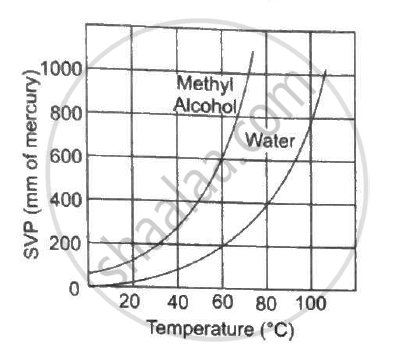
Using figure, find the boiling point of methyl alcohol at 1 atm (760 mm of mercury) and at 0.5 atm.
A glass contains some water at room temperature 20°C. Refrigerated water is added to it slowly. when the temperature of the glass reaches 10°C, small droplets condense on the outer surface. Calculate the relative humidity in the room. The boiling point of water at a pressure of 17.5 mm of mercury is 20°C and at 8.9 mm of mercury it is 10°C.
Answer in brief:
Show that rms velocity of an oxygen molecule is `sqrt2` times that of a sulfur dioxide molecule at S.T.P.
Compare the rate of radiation of metal bodies at 727 °C and 227 °C.
What is the microscopic origin of temperature?
Assuming the expression for the pressure exerted by the gas on the wall of the container, it can be shown that pressure is ______.
According to the kinetic theory of gases, at a given temperature, molecules of all gases have the same ______.
At what temperature will therms velocity of a gas be four times its value at STP?
Which of the following materials is diathermanous?
Show that the average energy per molecule is directly proportional to the absolute temperature ‘T’ of the gas.
