Advertisements
Advertisements
प्रश्न
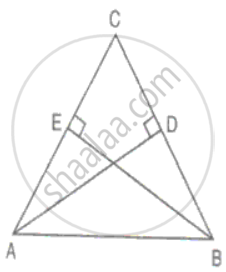
AD and BE are altitudes of an isosceles triangle ABC with AC = BC. Prove that AE = BD.
Advertisements
उत्तर
In ΔCAD and ΔCBE
CA = CB ...(Isosceles triangles)
∠CDA = ∠CEB = 90°
∠ACD = ∠BCE = ...(common)
Therefore, ΔCAD ≅ ΔCBE ...(AAS criteria)
Hence, CE = CD
But, CA = CB
⇒ AE + CE = BD + CD
⇒ AE = BD.
APPEARS IN
संबंधित प्रश्न
In a squared sheet, draw two triangles of equal areas such that
The triangles are congruent.
What can you say about their perimeters?
In triangles ABC and PQR, if ∠A = ∠R, ∠B = ∠P and AB = RP, then which one of the following congruence conditions applies:
ABC is an isosceles triangle such that AB = AC and AD is the median to base BC. Then, ∠BAD =

In the pair of triangles in the following figure, parts bearing identical marks are congruent. State the test and the correspondence of vertices by the triangle in pairs is congruent.

On the sides AB and AC of triangle ABC, equilateral triangle ABD and ACE are drawn. Prove that:
- ∠CAD = ∠BAE
- CD = BE
State, whether the pairs of triangles given in the following figures are congruent or not:

State, whether the pairs of triangles given in the following figures are congruent or not:

Sides, AB, BC and the median AD of ΔABC are equal to the two sides PQ, QR and the median PM of ΔPQR. Prove that ΔABC ≅ ΔPQR.

Prove that in an isosceles triangle the altitude from the vertex will bisect the base.
The congruent figures super impose each other completely.
