Advertisements
Advertisements
प्रश्न
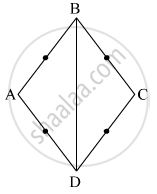
State, whether the pairs of triangles given in the following figures are congruent or not:
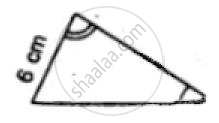
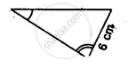
Advertisements
उत्तर
In these triangles, two sides and one angle of the one are equal to the corresponding sides and one angle of the other are equal.
Hence these are congruent triangles.
(A.A.S. Axiom).
APPEARS IN
संबंधित प्रश्न
If ΔABC ≅ ΔFED under the correspondence ABC ↔ FED, write all the Corresponding congruent parts of the triangles.
If ΔDEF ≅ ΔBCA, write the part(s) of ΔBCA that correspond to `bar(DF)`
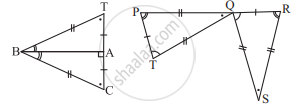
Complete the congruence statement:
ΔBCA ≅?
ΔQRS ≅?
In a ΔABC, if AB = AC and ∠B = 70°, find ∠A.
In two right triangles one side an acute angle of one are equal to the corresponding side and angle of the othe Prove that the triangles are congruent.
In the following example, a pair of triangles is shown. Equal parts of triangle in each pair are marked with the same sign. Observe the figure and state the test by which the triangle in each pair are congruent.
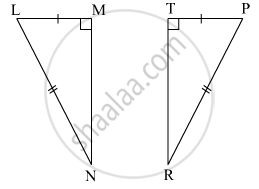
By ______ test
ΔLMN ≅ ΔPTR
In the given figure, seg AB ≅ seg CB and seg AD ≅ seg CD. Prove that ΔABD ≅ ΔCBD.
In a triangle ABC, if D is midpoint of BC; AD is produced upto E such as DE = AD, then prove that:
a. DABD andDECD are congruent.
b. AB = EC
c. AB is parallel to EC
Given that ∆ABC ≅ ∆DEF List all the corresponding congruent angles
It is given that ∆ABC ≅ ∆RPQ. Is it true to say that BC = QR? Why?
