Advertisements
Advertisements
प्रश्न
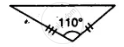
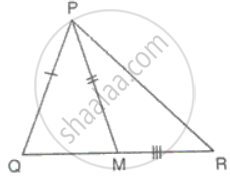
State, whether the pairs of triangles given in the following figures are congruent or not:
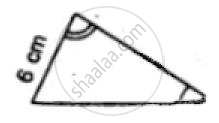
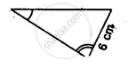
Advertisements
उत्तर
In these triangles, two sides and one angle of the one are equal to the corresponding sides and one angle of the other are equal.
Hence these are congruent triangles.
(A.A.S. Axiom).
APPEARS IN
संबंधित प्रश्न
If ΔABC ≅ ΔFED under the correspondence ABC ↔ FED, write all the Corresponding congruent parts of the triangles.
If ΔABC ≅ ΔABC is isosceles with
If ABC and DEF are two triangles such that ΔABC \[\cong\] ΔFDE and AB = 5cm, ∠B = 40°
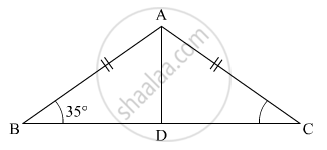
ABC is an isosceles triangle such that AB = AC and AD is the median to base BC. Then, ∠BAD =
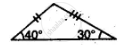
State, whether the pairs of triangles given in the following figures are congruent or not:
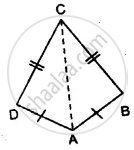
Prove that:
(i) ∆ ABC ≅ ∆ ADC
(ii) ∠B = ∠D
(iii) AC bisects angle DCB
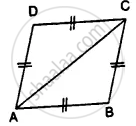
Prove that:
(i) ∆ ABC ≅ ∆ ADC
(ii) ∠B = ∠D
Sides, AB, BC and the median AD of ΔABC are equal to the two sides PQ, QR and the median PM of ΔPQR. Prove that ΔABC ≅ ΔPQR.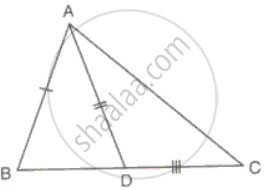
Prove that in an isosceles triangle the altitude from the vertex will bisect the base.
Without drawing the triangles write all six pairs of equal measures in the following pairs of congruent triangles.
∆ABC ≅ ∆LMN
