मराठी
कर्नाटक बोर्ड पी.यू.सी.पीयूसी विज्ञान 2nd PUC Class 12

AC = CO = D, S1C = S2C = d << D A small transparent slab containing material of µ = 1.5 is placed along AS2 (Figure). What will be the distance from O of the principal maxima - Physics

Advertisements
Advertisements

प्रश्न


AC = CO = D, S1C = S2C = d << D

A small transparent slab containing material of µ = 1.5 is placed along AS2 (Figure). What will be the distance from O of the principal maxima and of the first minima on either side of the principal maxima obtained in the absence of the glass slab?

दीर्घउत्तर
Advertisements

उत्तर

When we introduce a thin transparent plate in front of one of the slits in YDSE, the fridge pattern shifts toward the side where the plate is present.
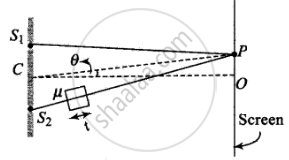

`(S_2O^')_("new") = (S_2O^' - t)_("air") + t_("plate") = (S_2O^' - t)_("air") + mut_("air")`

`(S_2O^')_("new") = S_2O^' + [mu(t - 1)]`

Path difference, `Δx = (S_2O^')_("new") - S_1O^' = (S_2O^' - S_1O^') + [mu(t - 1)]`

⇒ `Δx = d sin theta + [mu(t - 1)]`  ......(i)

⇒ Additional path difference = `(mu - 1)t`

Here the separation between the slits = S1S2 = 2d. Hence for calculating path difference, equation (i) becomes `Δx = 2d sin theta + [mu(t - 1)]`

For the principal maxima, (path difference is zero)

`Δx = 2d  sin theta_0 + [mu(t - 1)]` = 0

`sin theta_0 = - (L(mu - 1))/(2d) = (-L(0.5))/(2d)`  .....[∵ L = d/4]

or ⇒ `sin theta_0 = (-1)/16`

θ0 is the angular position corresponding to the principal maxima

⇒ `OP = D tan theta_0 ≈ D sin theta_0 = (_D)/16`

For the first minima, the path difference is `+- λ/2`

`Δx = 2d  sin theta_1  +  0.5 L = +- λ/2`

`sin theta_1 = (+- λ/2 - 0.5 L)/(2d) = (+- λ/2 - d/8)/(2d)`

⇒ `sin theta_1 = (+- λ/2 - λ/8)/(2λ) = +- 1/4 - 1/16`  ......[∵ The diffraction occurs if the wavelength of waves is nearly equal to the side width (d)]

On the positive side `sin theta_1^+ = + 1/4 - 1/16 = 3/16`

On the negative side `sin theta_1^- = 1/4 - 1/16 = - 5/16`

The first principal maxima on the positive side is at distance

`D  tan theta"'"_1^+ = D (sin theta"'"_1^+)/sqrt(1 - sin^2 theta_1^') = D 3/sqrt(16^2 - 3^2) = (3D)/sqrt(247)` above point O

The first principal minima on the negative side is at distance

`D  tan theta_1^+ = (5D)/sqrt(16^2 - 5^2) = (5D)/sqrt(231)` below point O.

shaalaa.com
  या प्रश्नात किंवा उत्तरात काही त्रुटी आहे का?
पाठ 10: Wave Optics - MCQ I [पृष्ठ ६६]

APPEARS IN

एनसीईआरटी एक्झांप्लर Physics [English] Class 12
पाठ 10 Wave Optics
MCQ I | Q 10.2 | पृष्ठ ६६

व्हिडिओ ट्यूटोरियलVIEW ALL [2]

संबंधित प्रश्‍न

What is 'diffraction of light'


For a single slit of width "a", the first minimum of the interference pattern of a monochromatic light of wavelength λ occurs at an angle of λa. At the same angle of λa, we get a maximum for two narrow slits separated by a distance "a". Explain.


Describe briefly how a diffraction pattern is obtained on a screen due to a single narrow slit illuminated by a monochromatic source of light. Hence obtain the conditions for the angular width of secondary maxima and secondary minima.


Explain two types of diffraction of light.


In Fraunhofer diffraction, how is the angular width of the central bright fringe affected when slit separation is increased?


Show graphically the intensity distribution in Fraunhofer's single slit diffraction experiment. Label the axes.


Draw the intensity distribution for the diffraction bands produced due to single slit ?


Two wavelengths of sodium light 590 nm and 596 nm are used, in turn to study the diffraction taking place at a single slit of aperture 2 × 10⁻⁴m. The distance between the slit and the screen is 1.5 m. Calculate the separation between the positions of the first maxima of the diffraction pattern obtained in the two cases.


In a single slit diffraction experiment, how does the angular width of the central maxima change when:

  1. screen is moved away from the plane of the slit?
  2. width of the slit is increased?
  3. light of larger wavelength is used?

What should be the order of obstacle or aperture for diffraction of light?


Wavelength of light of frequency 100 Hz is


Diffraction effects are easy to notice in the case of sound waves than in case of light waves because


Which of the following device is used to study the spectra of light?


Consider the diffraction pattern for a small pinhole. As the size of the hole is increased ______.

  1. the size decreases.
  2. the intensity increases.
  3. the size increases.
  4. the intensity decreases.

In a diffraction pattern due to a single slit, how will the angular width of the central maximum change, if the screen is moved closer to the slit?

Justify your answer.


In a diffraction pattern due to a single slit, how will the angular width of the central maximum change, if the slit width is decreased?

Justify your answer.


In a single slit Fraunhofer diffraction experiment, how does the angular width of the central maximum change when the slit width is Increased?


Share
Notifications

Englishहिंदीमराठी


      Forgot password?
Use app×