Advertisements
Advertisements
प्रश्न

AC = CO = D, S1C = S2C = d << D
A small transparent slab containing material of µ = 1.5 is placed along AS2 (Figure). What will be the distance from O of the principal maxima and of the first minima on either side of the principal maxima obtained in the absence of the glass slab?
Advertisements
उत्तर
When we introduce a thin transparent plate in front of one of the slits in YDSE, the fridge pattern shifts toward the side where the plate is present.
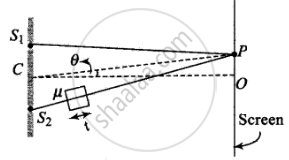
`(S_2O^')_("new") = (S_2O^' - t)_("air") + t_("plate") = (S_2O^' - t)_("air") + mut_("air")`
`(S_2O^')_("new") = S_2O^' + [mu(t - 1)]`
Path difference, `Δx = (S_2O^')_("new") - S_1O^' = (S_2O^' - S_1O^') + [mu(t - 1)]`
⇒ `Δx = d sin theta + [mu(t - 1)]` ......(i)
⇒ Additional path difference = `(mu - 1)t`
Here the separation between the slits = S1S2 = 2d. Hence for calculating path difference, equation (i) becomes `Δx = 2d sin theta + [mu(t - 1)]`
For the principal maxima, (path difference is zero)
`Δx = 2d sin theta_0 + [mu(t - 1)]` = 0
`sin theta_0 = - (L(mu - 1))/(2d) = (-L(0.5))/(2d)` .....[∵ L = d/4]
or ⇒ `sin theta_0 = (-1)/16`
θ0 is the angular position corresponding to the principal maxima
⇒ `OP = D tan theta_0 ≈ D sin theta_0 = (_D)/16`
For the first minima, the path difference is `+- λ/2`
`Δx = 2d sin theta_1 + 0.5 L = +- λ/2`
`sin theta_1 = (+- λ/2 - 0.5 L)/(2d) = (+- λ/2 - d/8)/(2d)`
⇒ `sin theta_1 = (+- λ/2 - λ/8)/(2λ) = +- 1/4 - 1/16` ......[∵ The diffraction occurs if the wavelength of waves is nearly equal to the side width (d)]
On the positive side `sin theta_1^+ = + 1/4 - 1/16 = 3/16`
On the negative side `sin theta_1^- = 1/4 - 1/16 = - 5/16`
The first principal maxima on the positive side is at distance
`D tan theta"'"_1^+ = D (sin theta"'"_1^+)/sqrt(1 - sin^2 theta_1^') = D 3/sqrt(16^2 - 3^2) = (3D)/sqrt(247)` above point O
The first principal minima on the negative side is at distance
`D tan theta_1^+ = (5D)/sqrt(16^2 - 5^2) = (5D)/sqrt(231)` below point O.
APPEARS IN
संबंधित प्रश्न
What is 'diffraction of light'
In the diffraction pattern due to a single slit of width 'd' with incident light of wavelength 'λ', at an angle of diffraction θ. the condition for first minimum is ....
(a)`lambda sin theta =d`
(b) `d costheta =lambda`
(c)`d sintheta=lambda`
(d) `lambda cos theta=d`
A point is situated at 7cm and 7·2 cm from two coherent sources. Find the· nature of illumination at the point if wavelength of light is 4000A.
Explain why the maxima at `theta=(n+1/2)lambda/a` become weaker and weaker with increasing n
Explain two types of diffraction of light.
Monochromatic light of wavelength 4300 Å falls on a slit of width ‘a’. For what value of ‘a’ the first maximum falls at 30° ?
In Fraunhofer diffraction, what kind of a source of light is used and where is it situated?
Wavelength of light of frequency 100 Hz is
The penetration of light into the region of geomaterial shadow is called.
Direction of the first secondary maximum in the Fraunhoffer diffraction pattern at a single slit is given by (a is the width of the slit):
Which of the following device is used to study the spectra of light?
Consider the diffraction pattern for a small pinhole. As the size of the hole is increased ______.
- the size decreases.
- the intensity increases.
- the size increases.
- the intensity decreases.
A polariod (I) is placed in front of a monochromatic source. Another polatiod (II) is placed in front of this polaroid (I) and rotated till no light passes. A third polaroid (III) is now placed in between (I) and (II). In this case, will light emerge from (II). Explain.
Four identical monochromatic sources A, B, C, D as shown in the (Figure) produce waves of the same wavelength λ and are coherent. Two receiver R1 and R2 are at great but equal distances from B.
- Which of the two receivers picks up the larger signal?
- Which of the two receivers picks up the larger signal when B is turned off?
- Which of the two receivers picks up the larger signal when D is turned off?
- Which of the two receivers can distinguish which of the sources B or D has been turned off?

Write two points of difference between an interference pattern and a diffraction pattern.
Derive the expression for the angular position of (i) bright and (ii) dark fringes produced in a single slit diffraction.
In a diffraction pattern due to a single slit, how will the angular width of the central maximum change, if orange light is used in place of green light?
Justify your answer.
In a diffraction pattern due to a single slit, how will the angular width of the central maximum change, if the screen is moved closer to the slit?
Justify your answer.
In the diagram shown, the separation between the slit is equal to 3λ, where λ is the wavelength of the light incident on the plane of the slits. A thin film of thickness 3λ and refractive index 2 has been placed in the front of the upper slit. The distance of the central maxima on the screen from O is ______.
In a single slit Fraunhofer diffraction experiment, how does the angular width of the central maximum change when the slit width is Increased?
