Advertisements
Advertisements
प्रश्न
ΔABC is an isosceles triangle in which AB = AC. Side BA is produced to D such that AD = AB (see the given figure). Show that ∠BCD is a right angle.

Advertisements
उत्तर
AB = AC ...[Given] ...(1)
AB = AD ...[Given] ...(2)
From (1) and (2), we have
AC = AD
Now, in ΔABC, we have
∠ABC + ∠ACB + ∠BAC = 180° ...[Angle sum property of a Δ]
⇒ 2∠ACB + ∠BAC = 180° ...(3) ...[∠ABC = ∠ACB (Angles opposite to equal sides of a Δ are equal)]
Similarly, in ΔACD,
∠ADC + ∠ACD + ∠CAD = 180°
⇒ 2∠ACD + ∠CAD = 180° ...(4) ...[∠ADC = ∠ACD (Angles opposite to equal sides of a Δ are equal)]
Adding (3) and (4), we have
2∠ACB + ∠BAC + 2∠ACD + ∠CAD = 180° +180°
⇒ 2[∠ACB + ∠ACD] + [∠BAC + ∠CAD] = 360°
⇒ 2∠BCD + 180° = 360° ...[∠BAC and ∠CAD form a linear pair]
⇒ 2∠BCD = 360° − 180°
⇒ 2∠BCD = 180°
⇒ ∠BCD = `(180°)/2`
Thus, ∠BCD = 90°
APPEARS IN
संबंधित प्रश्न
Show that the angles of an equilateral triangle are 60° each.
Find the measure of each exterior angle of an equilateral triangle.
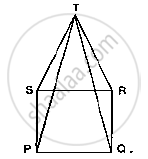
In Fig. 10.23, PQRS is a square and SRT is an equilateral triangle. Prove that
(i) PT = QT (ii) ∠TQR = 15°
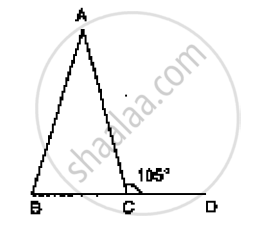
In Figure 10.24, AB = AC and ∠ACD =105°, find ∠BAC.
Two lines AB and CD intersect at O such that BC is equal and parallel to AD. Prove that the lines AB and CD bisect at O.
If the bisector of the exterior vertical angle of a triangle be parallel to the base. Show that the triangle is isosceles.
PQR is a triangle in which PQ = PR and S is any point on the side PQ. Through S, a line is drawn parallel to QR and intersecting PR at T. Prove that PS = PT.
Fill the blank in the following so that the following statement is true.
Sides opposite to equal angles of a triangle are ......
Fill the blank in the following so that the following statement is true.
If altitudes CE and BF of a triangle ABC are equal, then AB = ....
In ΔABC, if ∠A = 40° and ∠B = 60°. Determine the longest and shortest sides of the triangle.
Which of the following statements are true (T) and which are false (F)?
Sum of any two sides of a triangle is greater than the third side.
Fill in the blank to make the following statement true.
The sum of three altitudes of a triangle is ..... than its perimeter.
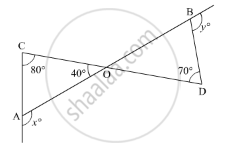
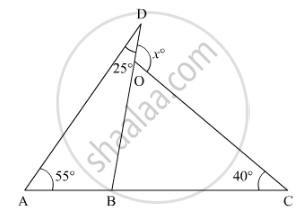
In the given figure, x + y =
In the given figure, for which value of x is l1 || l2?
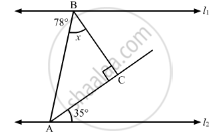
In the given figure, the value of x is ______.
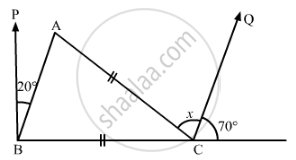
In the given figure, if BP || CQ and AC = BC, then the measure of x is
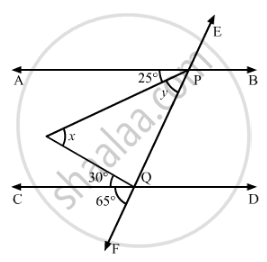
In the given figure, AB and CD are parallel lines and transversal EF intersects them at Pand Q respectively. If ∠APR = 25°, ∠RQC = 30° and ∠CQF = 65°, then
The angles of a right angled triangle are
If ∆PQR ≅ ∆EDF, then is it true to say that PR = EF? Give reason for your answer
